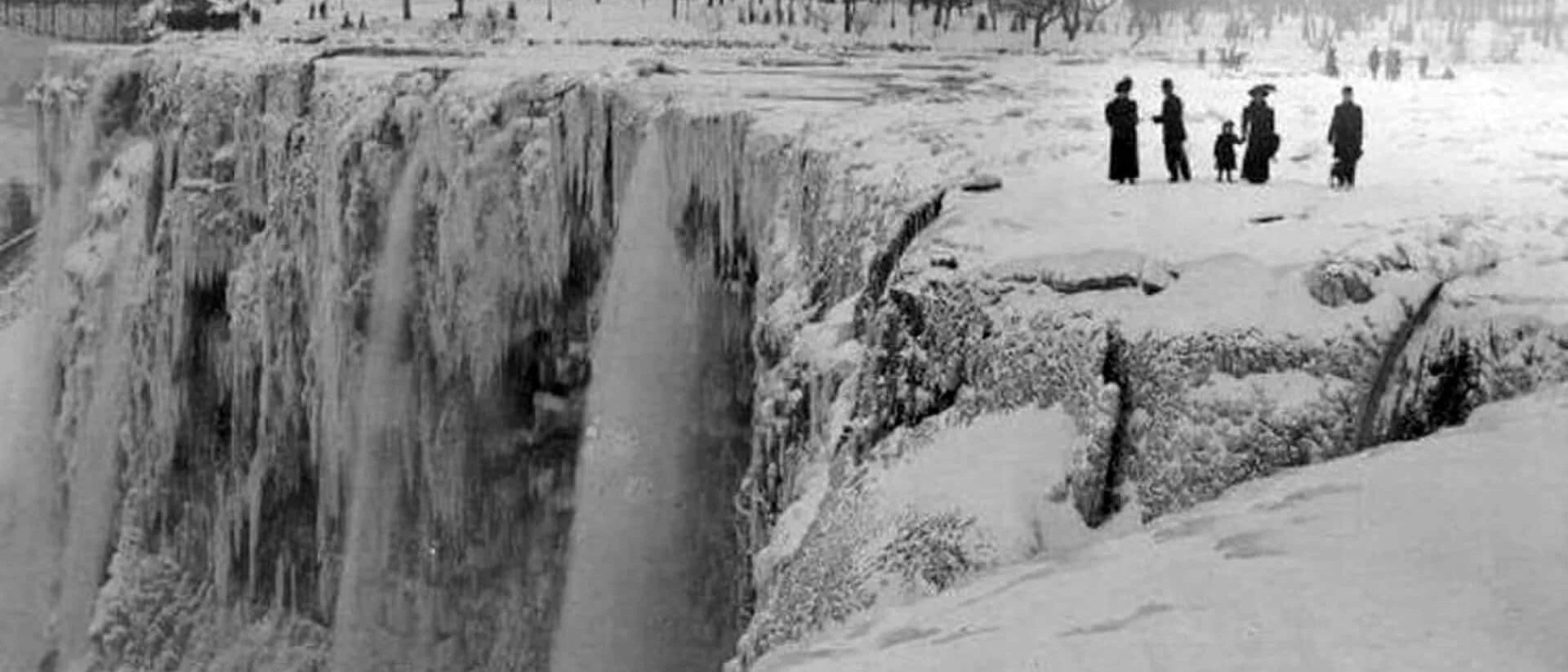
The winter of 1912 was so cold that Niagara Falls partially froze, creating a massive ice bridge that tourists could walk across.
When Niagara Falls Froze Into a Winter Wonderland
Picture this: it's 1912, and you're standing on top of Niagara Falls. Not beside it, not viewing it from a platform—actually walking across a frozen bridge of ice that's formed at the base of one of the world's most powerful waterfalls.
That's exactly what thousands of adventurous tourists did during the brutal winter of 1911-1912.
The Ice Bridge Phenomenon
Niagara Falls has never truly "frozen solid"—the sheer volume of water (750,000 U.S. gallons per second) makes a complete freeze physically impossible. But during exceptionally cold winters, something almost as remarkable happens.
Ice from Lake Erie breaks apart and flows down the Niagara River, accumulating at the base of the falls. When temperatures plunge and stay below freezing, this ice debris compacts into a thick, solid mass called an ice bridge. In 1912, this frozen platform stretched across the entire base of the falls and reached depths of 40 to 50 feet.
A Frozen Carnival
What did people do with this natural wonder? They turned it into a party.
- Vendors set up shanties selling food, drinks, and souvenirs directly on the ice
- Tourists posed for photographs on the frozen expanse
- Daredevils walked from the American side to the Canadian side
- Some visitors even brought sleds and ice skates
For decades, walking the ice bridge was an unofficial Niagara Falls tradition. Authorities looked the other way as thousands of people scrambled onto the ice each winter, creating an impromptu carnival atmosphere against the backdrop of partially frozen cascades.
The Tragedy That Changed Everything
The carefree ice bridge era came to a devastating end on February 4, 1912—the same winter that created such spectacular conditions. Without warning, the ice bridge broke apart while people were still on it.
Three people died that day: Eldridge Stanton, his wife Clara, and teenager Burrell Heacock. They were swept into the freezing rapids when the ice suddenly gave way. Rescuers could only watch helplessly as the victims clung to ice chunks before disappearing into the gorge.
After this tragedy, authorities permanently banned walking on the ice bridge. The practice that had entertained tourists for over a century was finished.
The Falls Still Freeze—Sort Of
Extreme cold still creates dramatic ice formations at Niagara Falls. The mist from the falls freezes on every surface it touches, creating ethereal ice sculptures on rocks, railings, and trees. In particularly harsh winters, so much ice builds up that the falls appear frozen from certain angles.
The most recent "frozen" Niagara occurred during the polar vortex of 2014 and 2015, when stunning photographs of ice-covered falls went viral. But even then, water continued flowing beneath the frozen facade.
The 1912 freeze remains legendary not just for its severity, but for marking the end of an era when humans and nature interacted with a casualness we can barely imagine today. Those ice bridge photographs—showing Victorian-era tourists strolling across frozen mist at the foot of a thundering waterfall—capture a moment of wonder and recklessness we'll never see again.
Frequently Asked Questions
Has Niagara Falls ever completely frozen?
When did Niagara Falls freeze in 1912?
Can you walk on Niagara Falls when it freezes?
What is a Niagara Falls ice bridge?
When was the last time Niagara Falls froze?
Verified Fact
This fact has been reviewed and verified against original sources.
Show verification details
Corrected from 'froze over' to 'partially froze' - the falls have never completely frozen due to water volume, but ice bridges and dramatic ice formations did occur in 1912 and other cold winters.