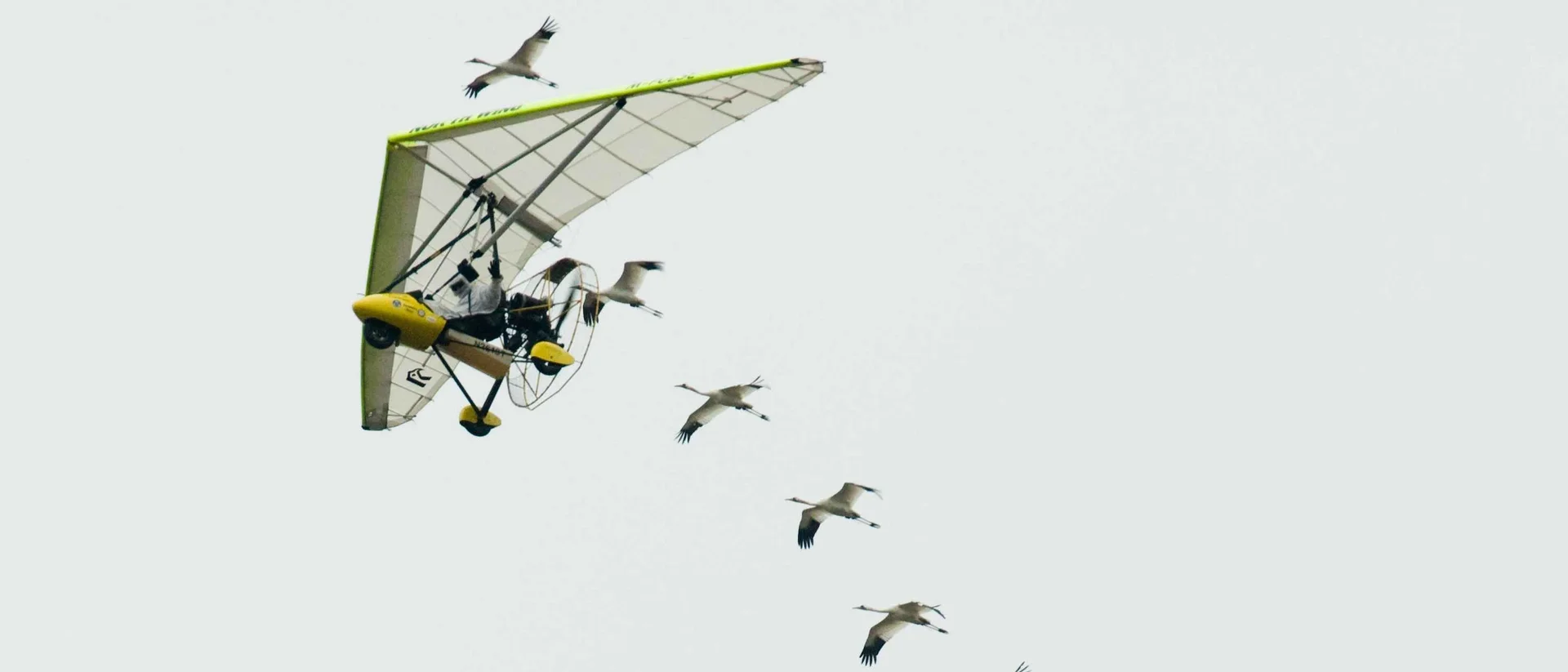
Captive-raised whooping crane chicks had no parents to show them the way south, so pilots in white crane costumes did it instead. The chicks heard a recording of an ultralight engine while still in the egg, then followed the tiny plane 1,200 miles from Wisconsin to Florida. In all, 186 cranes learned the route that way, and their flock still migrates every year on its own.
Meet the Pilots Who Dressed as Cranes to Save Them
For fifteen autumns, people in the countryside between Wisconsin and Florida could look up and see a tiny aircraft puttering low across the sky, with a line of enormous white birds flying right behind it. The pilot was dressed as a crane.
Fewer Than Two Dozen Birds
Whooping cranes are North America's tallest bird, standing nearly five feet with a seven-foot wingspan. Hunting and wetland loss pushed them to the edge of extinction. By 1941, fewer than two dozen were left in the wild: about 15 in the flock that migrated between Canada and Texas, plus a small group in Louisiana that did not migrate and later died out.
Conservationists spent decades building the flock back up through captive breeding. But by the 1990s, they faced a harder problem: the surviving wild whooping cranes only lived in one migratory population, in Texas and Canada. If disease or a single storm hit that flock, the species could vanish again. They needed a second migratory population, in a different part of the country.
The catch was that migration routes are not instinctive in whooping cranes. Chicks normally learn the path by flying it once alongside their parents. Captive-raised chicks had no parents to follow.
The Costume and the Puppet
The nonprofit Operation Migration had already proven a strange-sounding fix worked with Canada geese and trumpeter swans: raise the chicks on the sound and sight of an ultralight aircraft, then have the aircraft fly the migration route, with the birds imprinted enough to follow.
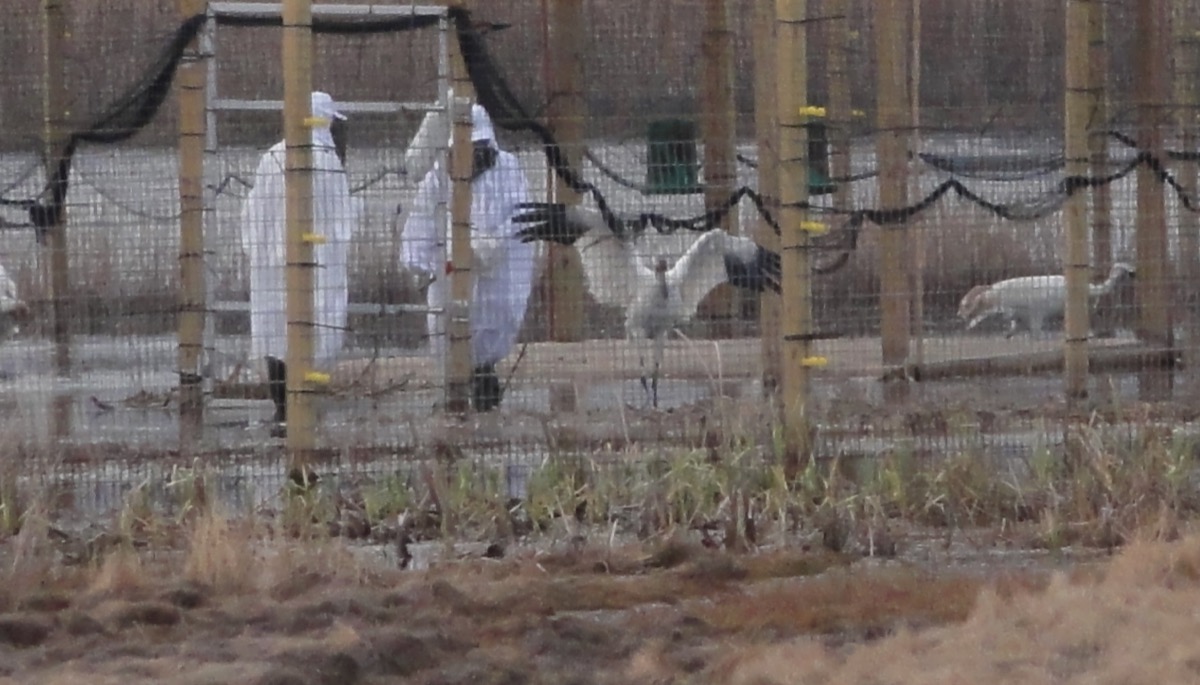
For whooping cranes, the method had to be even stricter. Handlers wore baggy white costumes that covered them head to toe, worked a crane-head hand puppet, and followed a strict no-talking rule around the chicks. Even before they hatched, the chicks were played recordings of an ultralight engine, so the sound was familiar from the start. The goal was to raise a bird that trusted the shape of a crane and the sound of an aircraft engine, but never learned to trust a human being.
Flying the Whooper Highway
Starting in 2001, a costumed pilot led the first class of eight young whooping cranes on a fall migration behind an ultralight aircraft, from Necedah National Wildlife Refuge in Wisconsin to Florida's Gulf Coast. Seven of them made it, and five flew back north on their own the next spring.
The route ran about 1,200 miles. The birds imprinted on the aircraft, tucked into the wind behind it, and followed it south in loose V formation, the same shape wild cranes use on their own migrations.
The flights became an annual event, repeated every autumn for fifteen years. Pilots and ground crews spent weeks working their way south, grounded for days at a time by weather, before the cranes reached their wintering grounds. In all, Operation Migration's pilots led 186 young whooping cranes south this way between 2001 and 2015, according to the Wisconsin Society for Ornithology.
A U.S. Fish and Wildlife Service official later described the project as "the wildlife equivalent of putting a man on the moon."
Why the Program Ended
The ultralight-led flights stopped after the 2015 season. Researchers had noticed a problem: many of the costume-raised cranes found mates and laid eggs just fine, but struggled to raise their own chicks once they hatched.
Wildlife biologists suspected the birds had missed something important by never watching a real adult crane parent a chick. In 2016, the U.S. Fish and Wildlife Service withdrew support for the aircraft-led method and shifted toward letting wild or captive crane pairs raise the young themselves.
The Flock Still Flies
The population the ultralights built, known as the Eastern Migratory Population, still exists. As of spring 2026, the International Crane Foundation estimated it at 64 birds, 15 of them hatched in the wild and the rest reared in captivity.
Every year, without a costume or an aircraft in sight, that flock migrates on its own between the upper Midwest and the southern United States, tracing a version of the route the costumed pilots first showed them.
Across North America, the whooping crane population has climbed from fewer than two dozen wild birds in 1941 to roughly 800 today, in the wild and in captivity combined.
Enjoyed this fact?
2 people loved this
Get a new fact every morning.
A fascinating fact in your inbox every morning. Free. Unsubscribe anytime.
Frequently Asked Questions
Why did pilots dress up as whooping cranes?
How far did the ultralight-led whooping cranes migrate?
Why did the ultralight migration program end?
How many whooping cranes are alive today?
Does the population from Operation Migration still migrate?
Verified Fact
6 sources checked
Source: Smithsonian National Air and Space MuseumShow verification details
Claims checked
- Pilots in white crane costumes led captive-raised chicks about 1,200 miles from Wisconsin to Florida behind ultralights
- Chicks heard recordings of the engine while still in the egg
- Number of cranes led corrected to 186 (was more than 200)
- The 1941 low corrected to fewer than two dozen wild birds (was 16)
- The eastern flock, about 64 birds in 2026, still migrates every year on its own
Sources: Smithsonian Air and Space, Wisconsin Society for Ornithology, International Crane Foundation, U.S. Fish and Wildlife Service, The Revelator, Wikipedia
Related Topics
More from Animals
View all Animals →