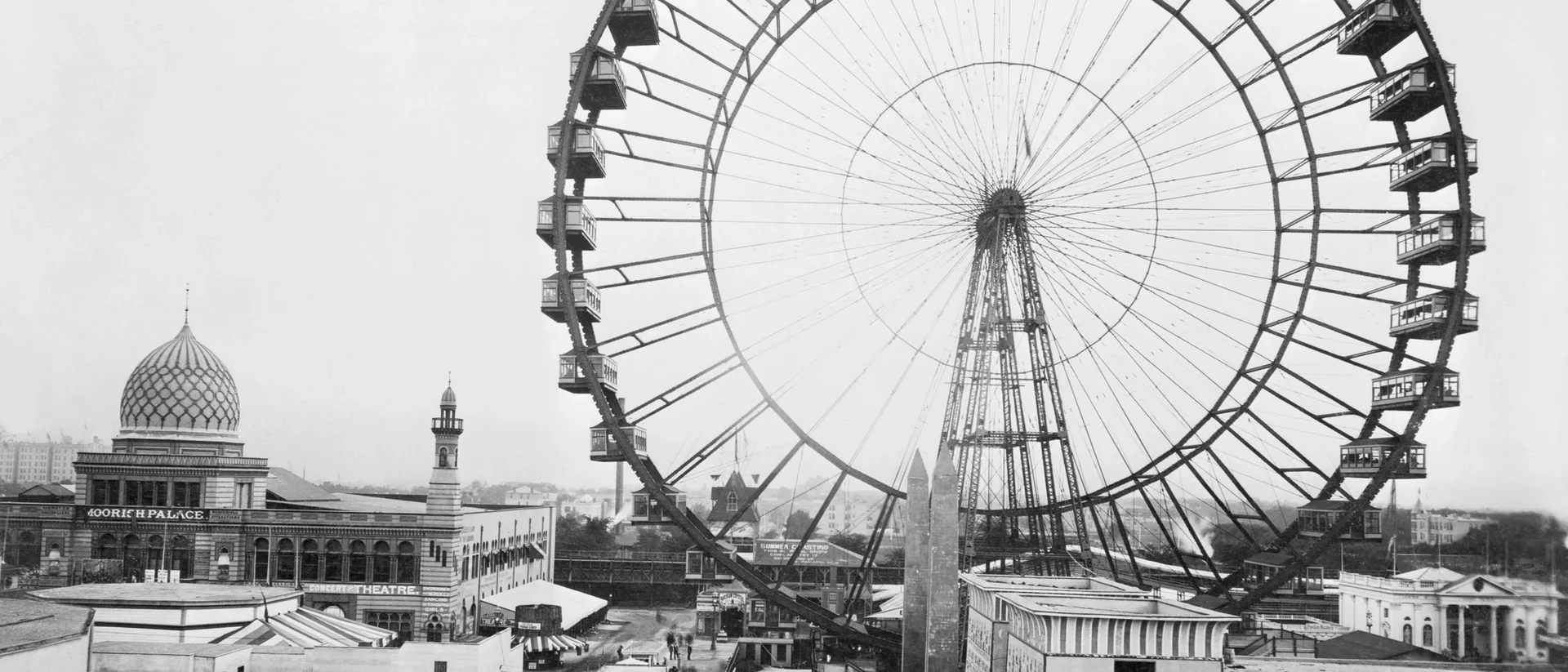
The first Ferris wheel was built to out-Eiffel the Eiffel Tower at the 1893 Chicago World's Fair. It stood 264 feet tall. Each of its 36 cars was the size of a train carriage. Together they could carry up to 2,160 riders at once. After the fair, no buyer wanted the giant machine. In 1906, workers dynamited it into scrap.
The Ferris Wheel Built to Beat the Eiffel Tower
Long before Ferris wheels became a staple of every county fair, there was one built to humiliate an entire country's engineering pride. It stood 264 feet tall, carried more than two thousand people at once, and was demolished with dynamite less than fifteen years after it opened.
A Challenge to Out-Eiffel the Eiffel Tower
When organizers of the 1893 World's Columbian Exposition in Chicago started planning, they had one goal: build something that would make Paris's Eiffel Tower look small. The Eiffel Tower had stunned the world at the 1889 Paris Exposition, and American engineers were publicly challenged to top it. Bridge engineer George Washington Gale Ferris Jr. answered with an idea nobody had tried before: a giant rotating wheel that visitors could ride.
A Wheel Built From Train Cars
Ferris's wheel stood 264 feet tall and turned on a 71-ton, 45.5-foot axle that was, at the time, the largest hollow piece of forged steel ever made. It held 36 passenger cars, each roughly the size of a train carriage, fitted with 40 revolving chairs and room to stand. Fully loaded, a single rotation carried 2,160 riders into the sky at once.
Nearly 1.5 Million Riders
The wheel opened to the public on June 21, 1893, and quickly became the most talked-about attraction at the fair. Visitors paid 50 cents for a 10 to 20 minute ride, and by the time the exposition closed, close to 1.5 million people had bought tickets. Newspapers on both sides of the Atlantic agreed: America had done it. The wheel really had out-Eiffeled the Eiffel Tower.
Sold for Scrap and Blown to Pieces
The wheel's success did not last. After the Chicago fair, it was dismantled and shipped to St. Louis for the 1904 World's Fair, where it drew crowds again. But once that fair closed, no buyer could be found who was willing to pay to move or maintain it. St. Louis's contract required Forest Park to be restored to its original condition, so on May 11, 1906, demolition crews packed the wheel with dynamite and brought it down in a single blast, then sold the wreckage for scrap.
George Ferris never saw the wheel's demolition. He died of typhoid fever in 1896, a decade before his creation was reduced to twisted metal. What became of the wreckage is still debated: a 2007 magnetic survey detected what might be the buried axle near the old fairground, though it has never been excavated, and other historical records suggest it was actually hauled back to Chicago and cut apart for scrap instead.
Frequently Asked Questions
Who built the first Ferris wheel?
Why was the first Ferris wheel built?
How many people could the original Ferris wheel hold?
How tall was the original 1893 Ferris wheel?
What happened to the original Ferris wheel?
Verified Fact
Verified Jul 2, 2026 · 2 sources checked
Source: WikipediaShow verification details
Claims checked
- Built to rival the Eiffel Tower at the 1893 Chicago World's Fair
- Stood 264 feet tall with 36 cars holding up to 2,160 riders
- Cars described as about the size of train carriages
- Dynamited into scrap in 1906 after no buyer was found
Sources: Wikipedia
Related Topics
More from History & Culture
View all History & Culture →