Kate Shelley was a teenager when an 1881 storm collapsed a trestle near her Iowa home. A passenger train with 200 people aboard was still coming. She crawled across a flooded railroad bridge on her hands and knees, lantern blown out. She reached the depot in time to stop the train. Railroads gave her a lifetime pass and a Tiffany medal. Today, Union Pacific trains still cross the bridge that bears her name.

She Crawled a Flooded Railroad Bridge to Save 200 Lives

1 viewsPosted 12 days agoUpdated 3 minutes ago

On the night of July 6, 1881, a violent thunderstorm tore through Boone County, Iowa, and washed out a small railroad trestle over Honey Creek. A pusher locomotive carrying four crewmen plunged into the flooded creek when the trestle gave way beneath it. Teenage Kate Shelley heard the crash from her family's farmhouse nearby.

Sources disagree on exactly how old she was that night. Her gravestone gives a birth date of September 1865, which would make her 15; other biographical accounts place her birth in December 1863, making her 17. Either way, she was a teenager.

A Wreck in the Dark

Shelley ran out into the storm and found two of the crewmen, Edgar Wood and Adam Agar, clinging to trees in the rising water. She could not reach them herself.

Two other crewmen, Pat Donahue and A.P. Olmsted, did not survive the wreck.

Shelley knew something the men in the water did not. A passenger train, the eastbound express, was due to cross the same stretch of track within the hour, carrying roughly 200 passengers toward the washed-out bridge.

Across the Bridge on Her Hands and Knees

To reach the nearest depot and stop the train, Shelley had to cross the railroad bridge over the Des Moines River on foot, in the dark, in the same storm that had just destroyed the Honey Creek trestle.

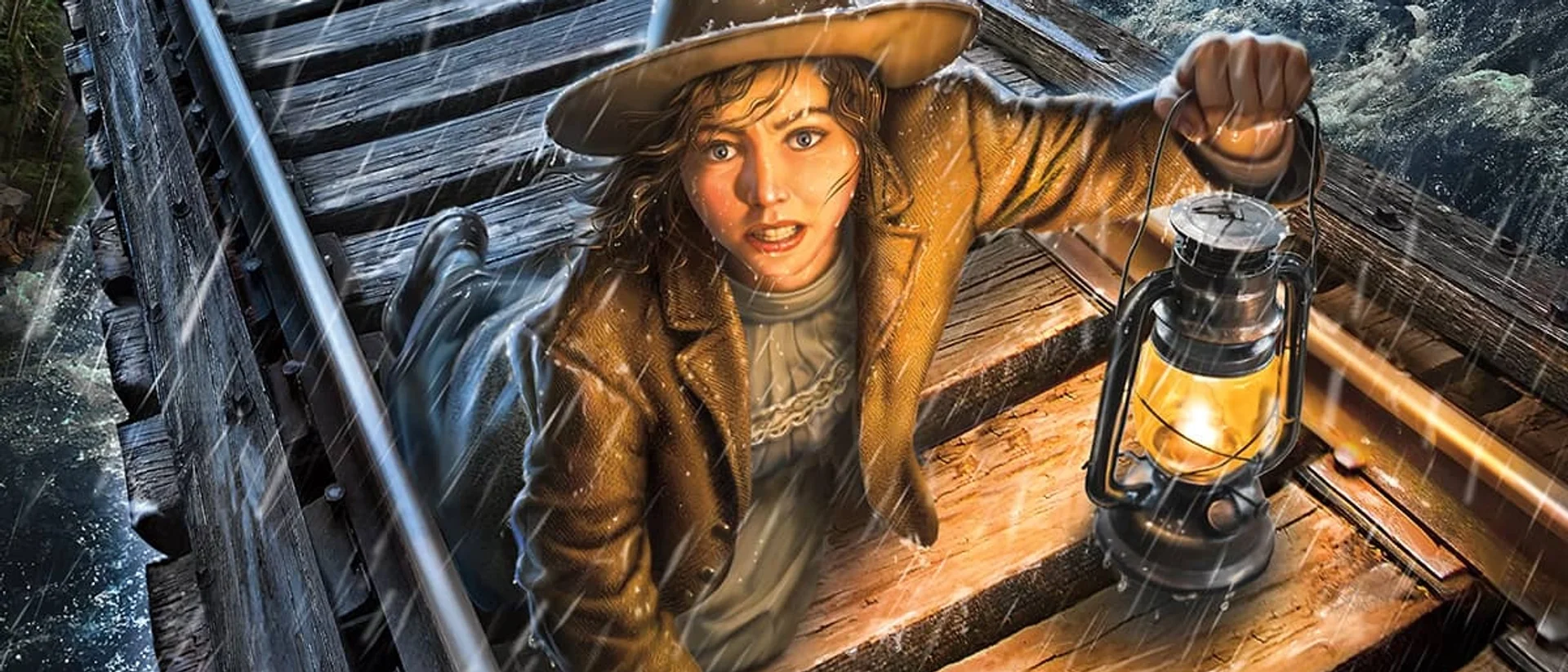
There was no walkway. She crawled the length of the bridge on her hands and knees, feeling for each railroad tie beneath her before trusting her weight to it.

Partway across, her lantern blew out in the wind. She finished the crossing in total darkness, with the flooded river running beneath the ties.

Once she reached the far side, she still had close to two miles to walk to the Moingona depot.
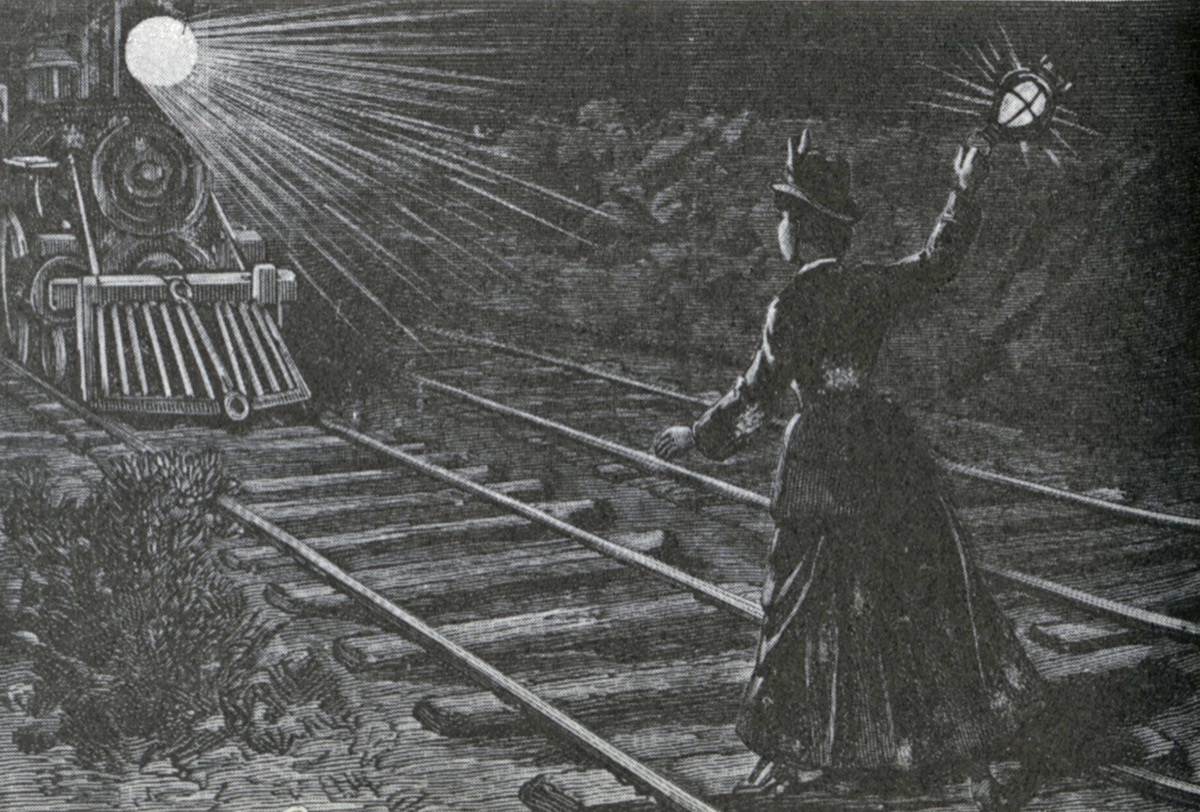
Contemporary 19th-century newspaper illustration of Kate Shelley signaling an oncoming train at night with a lantern
Kate Shelley warning the approaching train - a contemporary newspaper illustration.

She Reached the Depot in Time

Shelley made it to Moingona and raised the alarm before the express train reached the damaged crossing. Railroad workers stopped the train at Scranton, Iowa, with all 200 passengers safe.

A rescue crew later went out and recovered Wood and Agar from the creek, alive.

A Lifetime of Honors

News of Shelley's crossing spread quickly, and the honors followed. The "little girls" of Dubuque sent her a medal. The state of Iowa gave her a medal made by Tiffany & Co., along with $200.

The Chicago and North Western Railway gave her $100, a half barrel of flour, half a load of coal, and a lifetime railway pass. The Order of Railway Conductors gave her a gold watch and chain.

In 1903, after fire destroyed the original Moingona depot, the railroad gave Shelley a job as its station agent there. She held the post until her death in 1912.

The Bridge That Bears Her Name

In 1901, the railroad replaced the old bridges near Boone with a new steel viaduct across the Des Moines River valley: 2,685 feet long and 185 feet above the water. It was named the Kate Shelley High Bridge.

A new double-track bridge opened alongside it in August 2009: 2,813 feet long and 190 feet above the valley floor, built to carry two trains at once at 70 miles per hour. Union Pacific officially named it the Kate Shelley Bridge.

Freight and passenger trains still cross it today, more than a century after a teenage girl crawled across the old bridge in the dark to save 200 strangers she would never meet.

Enjoyed this? Get a new fact every day.

Follow FunFactz for the best ones in your feed.

or get one in your inbox

Frequently Asked Questions

How old was Kate Shelley when she saved the train?
Sources disagree on her exact age. Her gravestone gives a birth date of September 1865, which would make her 15 that night; other biographical accounts place her birth in December 1863, making her 17. Either way, she was a teenager on July 6, 1881, when a storm collapsed the Honey Creek trestle near her Iowa home. She crawled across a flooded railroad bridge in the dark to warn a passenger train with about 200 people aboard before it reached the washed-out crossing.
What happened to the train Kate Shelley stopped?
Railroad workers stopped the eastbound express at Scranton, Iowa, after Shelley reached the Moingona depot and raised the alarm. All roughly 200 passengers aboard were kept safe and never reached the damaged bridge.
Did anyone die in the Honey Creek trestle collapse?
Yes. A pusher locomotive with four crewmen fell into Honey Creek when the trestle collapsed in the storm. Two crewmen, Pat Donahue and A.P. Olmsted, died, while two others, Edgar Wood and Adam Agar, were later rescued from the water alive.
What rewards did Kate Shelley receive for her heroism?
Shelley received a Tiffany and Co. medal and $200 from the state of Iowa, a cash award and a lifetime railway pass from the Chicago and North Western Railway, and a gold watch and chain from the Order of Railway Conductors. In 1903 the railroad also made her the station agent at Moingona depot.
Where is the Kate Shelley Bridge and how big is it?
The Kate Shelley Bridge carries Union Pacific trains across the Des Moines River valley near Boone, Iowa. The current bridge, opened in 2009, is 2,813 feet long and 190 feet above the valley floor, replacing an 1901 viaduct of similar size that first carried her name.

Verified Fact

This fact has been reviewed and verified against original sources.

Source: Wikipedia / Union Pacific Historical Records
Show verification details

Audited 2026-08-06. Fact-verifier independent audit (numeric coherence, citation fidelity, claim-source tracing, superlative counterexample hunt). Sources: (1) en.wikipedia.org/wiki/Kate_Shelley (2) en.wikipedia.org/wiki/Kate_Shelley_High_Bridge (3) kateshelley.com/about-kate.html. AGE CORRECTED: creator shipped a flat "seventeen," citing kateshelley.com and reading the Wikipedia bio page as agreeing. On direct check this is false - Wikipedia carries the age as genuinely disputed and inconsistently between its own two articles: the Kate Shelley bio page opens with a Dec 12 1863 baptismal date (=17) that is marked [citation needed] with no source, then separately notes her grave marker gives Sept 25 1865 (=15); the Kate Shelley High Bridge page leads the OPPOSITE way, stating she was "15 years old" and noting "in some versions... 17," explicitly framing 17 as the account that disputes her own gravestone. kateshelley.com (a promotional site for a forthcoming book, not a museum/archival authority) asserts 17 while itself stating the gravestone date is incorrect - i.e. it openly overrides the primary-adjacent artifact rather than resolving the conflict. No source found with an actual citation for the 1863 date; the only physical evidence (the gravestone) says 1865. Verdict: genuinely split, not "17 by most accounts." Corrected text/social_text/social_caption/article to "teenager"/"teenage" (true under either reading) and rewrote FAQ #1 to state the split explicitly (this was the single most scrapable instance of the false-precision claim). Kept engagement/link comments as-is (no age claim in either). CITATION-FIDELITY FAIL ALSO FOUND AND FIXED: article claimed "It was, by most accounts, the first railroad bridge in the country named after a woman, a distinction it held for decades" - creator notes attributed "first and...perhaps the only" to the Kate Shelley High Bridge Wikipedia page, but a direct fetch shows that page makes NO such claim at all. "By most accounts" pointed at accounts that could not be located - cut the sentence entirely; the fact loses nothing since "a bridge carries her name" is independently sourced. CONFIRMED: Union Pacific "officially named" the 2009 bridge the Kate Shelley Bridge (Wikipedia High Bridge page, verbatim "The UP officially named the new viaduct the Kate Shelley Bridge") - this claim stands. Numeric coherence: 1901 bridge 2685 ft/185 ft, 2009 bridge 2813 ft/190 ft opened Aug 20 2009, both confirmed verbatim against Wikipedia - no invented precision. Rescue narrative confirmed against Wikipedia: Honey Creek trestle collapse July 6 1881, pusher locomotive/4 crew, 2 died (Donahue, Olmsted) / 2 survived (Wood, Agar) later rescued alive, Shelley crawled the Des Moines River bridge on hands/knees after lantern blew out (lightning only), roughly 2 miles walked to Moingona depot, roughly 200-passenger express stopped at Scranton. Honors confirmed: Dubuque medal, Iowa Tiffany and Co medal plus 200 dollars, C&NW 100 dollars plus flour plus coal plus lifetime pass, Order of Railway Conductors gold watch and chain, 1903 station agent job. Two crew fatalities (Donahue, Olmsted) correctly stay OUT of text/social_text/social_caption/social_engagement_comment; only appear in article and one FAQ, as intended. No invented precision found elsewhere (no bridge-length or train-name embellishment beyond sourced figures). engine=1 (anonymous+exceptional) confirmed correct, not downgraded; engine_note updated to remove stale pre-Jun22 "not prime-eligible" language. mainstream_novelty=2 confirmed reasonable (angle is the crawl/bridge-naming payoff, not a recycled viral chestnut). proof_photo_strength and beat_freshness were NULL at creation despite the commissioning brief assuming pf=2 - set proof_photo_strength=1 (borderline): no photograph of the 1881 event exists (predates action photography of this kind), only a contemporary newspaper engraving/illustration plus modern photos of the bridge itself - real and usable but not a slam-dunk "sells it in 1 second" photo, so image-curator should lean on the illustration plus a strong modern/historic bridge photo rather than expect a dramatic period photograph. beat_freshness=2 (checked DB for recent lone-hero/flood/bridge/train-stop facts - closest are winnipeg-1997-flood, a mass sandbag effort not a solo hero, and harrison-okene, a survival story not a rescue-of-others - no near-duplicate of this sub_beat found; sub_beat "teen-hero-tribe-legend" is unique in the table). image_social/image_card/image_banner all confirmed NULL (pre-imaging) and no scheduled_posts row exists for this fact - no cascade actions (cancel/null-image) needed. NOTE for image-curator: article still contains a literal PLACEHOLDER-INLINE img src that must be resolved.

Related Topics

More from History & Culture

View all History & Culture