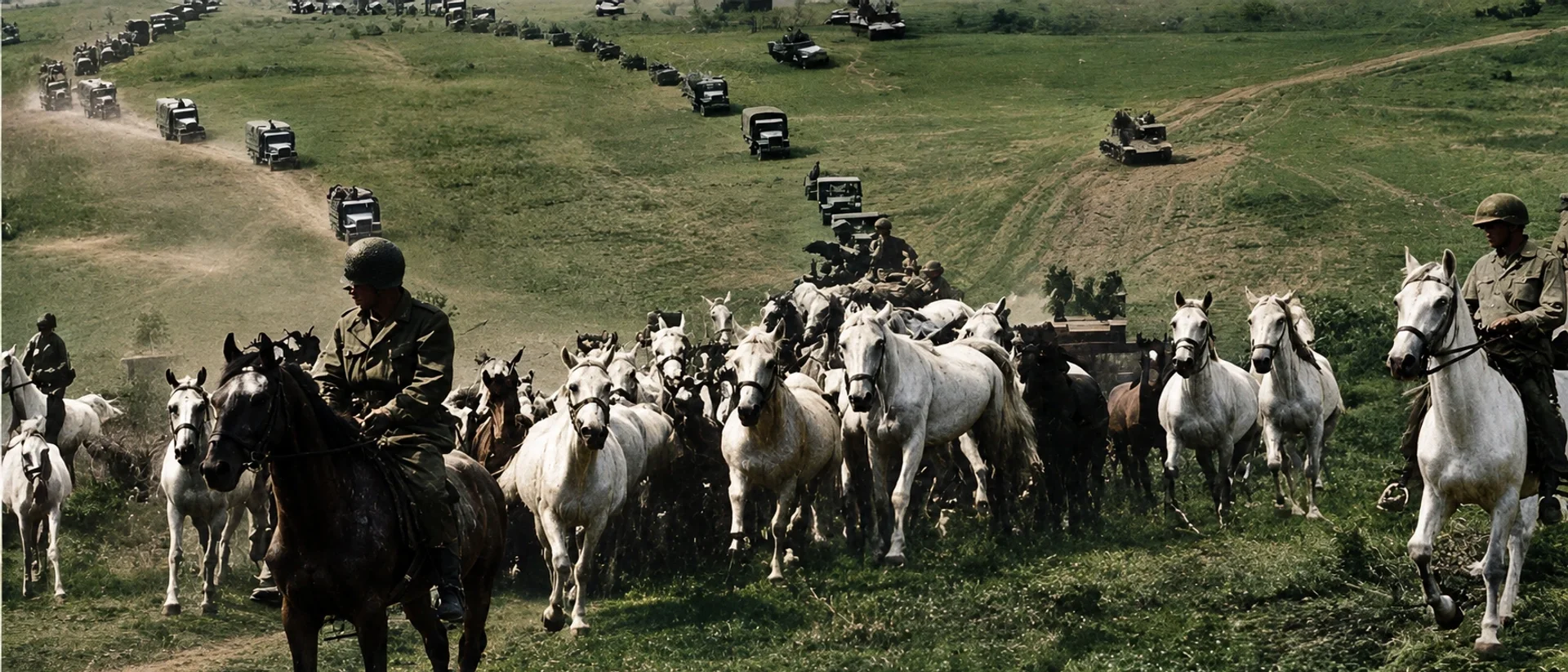
American cavalry soldiers teamed up with German troops who had just surrendered to them. Together they fought off the SS to save more than 1,200 horses in Czechoslovakia. The herd included Lipizzaner mares and foals that stock Vienna's Spanish Riding School. Colonel Charles Reed organized the raid days before Soviet tanks reached the farm. The Lipizzaner bloodline survived the war.
The WWII Raid Where Enemies Teamed Up to Save 1,200 Horses
By the last week of April 1945, the German army was collapsing across Europe, and a small stud farm in Hostau, Czechoslovakia held one of the strangest pieces of unfinished business left in the war: more than 1,200 horses, including the Lipizzaner mares and foals that stocked Vienna's famous Spanish Riding School.
A Farm Full of Stolen Horses
The Nazis had swept up horses from across occupied Europe and concentrated them at Hostau, including Arabians, thoroughbreds, and hundreds of captured Russian horses.
The Lipizzaner breeding herd had been moved there after German forces took over the Piber stud in Austria.
With the Red Army closing in from the east, the officers stationed at Hostau knew the horses would either be shelled in the crossfire or seized by the Soviets.
An Unlikely Surrender
Stranded at the farm with no fuel and a collapsing front, a German officer contacted the nearest American unit, the 2nd Cavalry Group under Colonel Charles Reed, part of General George Patton's Third Army.
The Germans offered to surrender Hostau and its horses on one condition: that the Americans evacuate the herd before the Soviets arrived.
Reed sent scouts to confirm the offer, then organized a task force to carry it out.
Fighting the SS Together
Patton approved the raid on the spot, reportedly telling his staff to move fast.
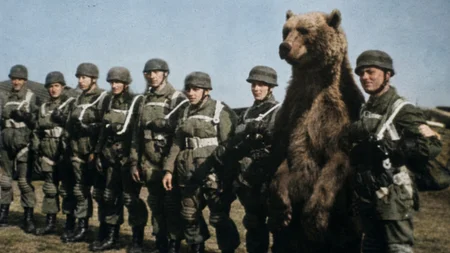
Reed's men rearmed the German soldiers who had just surrendered to them, and together the two former enemies built a defense line around the farm.
Waffen-SS units in the area tried to reach Hostau to stop the handover, and American and German troops fought them off side by side.
It stands as one of only two documented times in World War Two that American and German forces fought together against a common enemy, the other being the Battle of Castle Itter about a week later.
Getting the Herd Out
Over roughly two days, the joint force walked and trucked the herd west across contested ground toward American lines, all while dodging stray shelling and enemy patrols.
Along with the horses, they freed about 400 Allied prisoners of war who had been held at the farm.
Two American soldiers, Raymond Manz and Charles Sutton, were killed in the fighting to protect a herd that was not even theirs to begin with.
What Happened to the Horses
The herd made it across into American-held territory just as Soviet forces reached Hostau.
The rescued Lipizzaner mares and foals were eventually reunited with the Spanish Riding School's breeding program, preserving a bloodline that traces back centuries.
Patton later ordered his troops to protect the Riding School's performing stallions as well, a separate group that had already been evacuated to safety in Austria by their director, Alois Podhajsky.
Frequently Asked Questions
What was Operation Cowboy?
Did General Patton lead the rescue of the Lipizzaner horses?
How many horses were rescued at Hostau?
Were the Spanish Riding School's performing stallions rescued at Hostau?
Was Operation Cowboy the only time Americans and Germans fought together in WWII?
Verified Fact
Verified Aug 4, 2026 · 7 sources checked
Source: Military.comShow verification details
Claims checked
- Raid occurred on Apr 28, 1945, in Hostau, Czechoslovakia
- More than 1,200 horses saved, including 375 Lipizzaners
- Herd was Lipizzaner breeding mares and foals from Piber, not performing stallions
- Two US soldiers killed, PFC Raymond Manz and T/5 Charles Sutton (earlier version said several)
- About 400 Allied POWs were freed (earlier version added unsupported local refugees)
Sources: Military.com, Wikipedia, MilitaryHistoryNow.com, Army Historical Foundation, Sports Illustrated Vault, HistoryNet.com, Austrian Information
Related Topics
More from History & Culture
View all History & Culture →