Farmers near Xi'an, China were digging a well in March 1974 when their shovels hit a buried clay head. It led to the Terracotta Army: an estimated 8,000 soldiers, of which only 2,000 have been dug up so far. They guard the 2,200-year-old tomb of China's first emperor, a tomb that has never been opened. Ancient writers said it holds rivers of mercury, and soil tests found the mercury is real.
Farmers Dug a Well and Found an Army of 8,000 Statues
In the spring of 1974, a group of farmers in Shaanxi province, China, was digging a well to fight a drought. Their shovels hit something hard about 15 feet down. It was not rock. It was a face, made of clay, staring back up at them from the dirt.
A Drought, a Shovel, and a Buried Face
The farmers, led by a man named Yang Zhifa, were working near Xi'an on March 29, 1974, when they unearthed the fragments of a life-size clay figure.
Local officials were called in, and word reached archaeologists.
What they found beneath that dry field was not a single statue.
It was an army that had been standing guard, underground and unseen, for over 2,200 years.
An Army Two Thousand Years in the Making
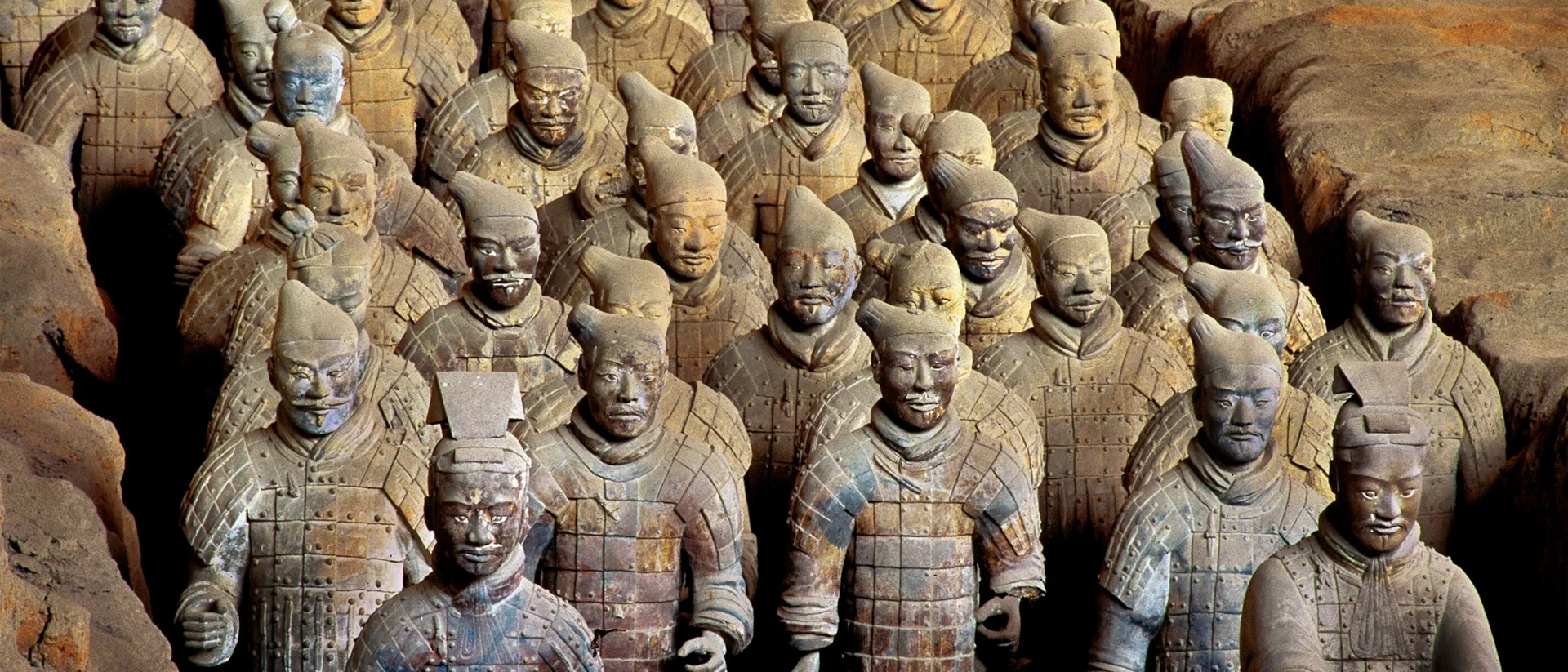
Excavations eventually revealed three massive pits that archaeologists believe hold an estimated 8,000 life-size soldiers, along with horses, chariots, and bronze weapons.
Only around 2,000 of those figures have actually been dug up so far.
The rest are still underground, left deliberately unexcavated.
The figures were built to protect the tomb of Qin Shi Huang, the first emperor to unite China, who ordered the project during his own lifetime.
What makes the army even stranger is the detail.
Craftsmen used a small number of base head molds, then hand-added clay features on top, mustaches, ears, topknots, and expressions, so that no two soldiers share the same face.
The figures were also originally painted in bright colors.
Almost none of that paint survives today.
Archaeologists have found that the lacquer beneath it can curl within seconds and flake away within minutes once it hits open air, which is part of why so much of the site remains carefully unexcavated.
The Tomb Nobody Has Opened
The soldiers were never the main event.
They were built to guard something bigger: the emperor's own burial mound, located about a mile away, which has never been excavated.
Centuries after the emperor's death, the historian Sima Qian wrote that the tomb's inner chamber contained a miniature map of China, with rivers and seas recreated in flowing liquid mercury.
For a long time, this sounded like myth.
Then modern soil tests around the mound turned up mercury concentrations far above normal background levels, concentrated in patterns that roughly match the rivers Sima Qian described.
Archaeologists have deliberately left the tomb sealed, citing both the toxic mercury and concerns about damaging whatever is inside before better preservation techniques exist.
More than 50 years after that first buried face turned up in a well, the emperor guarding it all is still waiting, undisturbed, underground.
Enjoyed this? Get a new fact every morning.
A fascinating fact in your inbox every morning. Free. Unsubscribe anytime.
Frequently Asked Questions
When was the Terracotta Army discovered?
How many terracotta soldiers are there?
Are the faces on the terracotta soldiers really all different?
Why hasn't the emperor's actual tomb been opened?
Were the terracotta soldiers originally painted?
Verified Fact
Verified Jul 12, 2026 · 3 sources checked
Source: National GeographicShow verification details
Claims checked
- Discovery by well-digging near Xi'an in March 1974
- ~8,000 estimated soldiers, ~2,000 excavated so far
- Mercury in tomb from ancient account, supported by modern soil tests
- Tomb never opened; each soldier has distinct facial features
Sources: National Geographic, South China Morning Post, Wikipedia
Related Topics
More from History & Culture
View all History & Culture →