
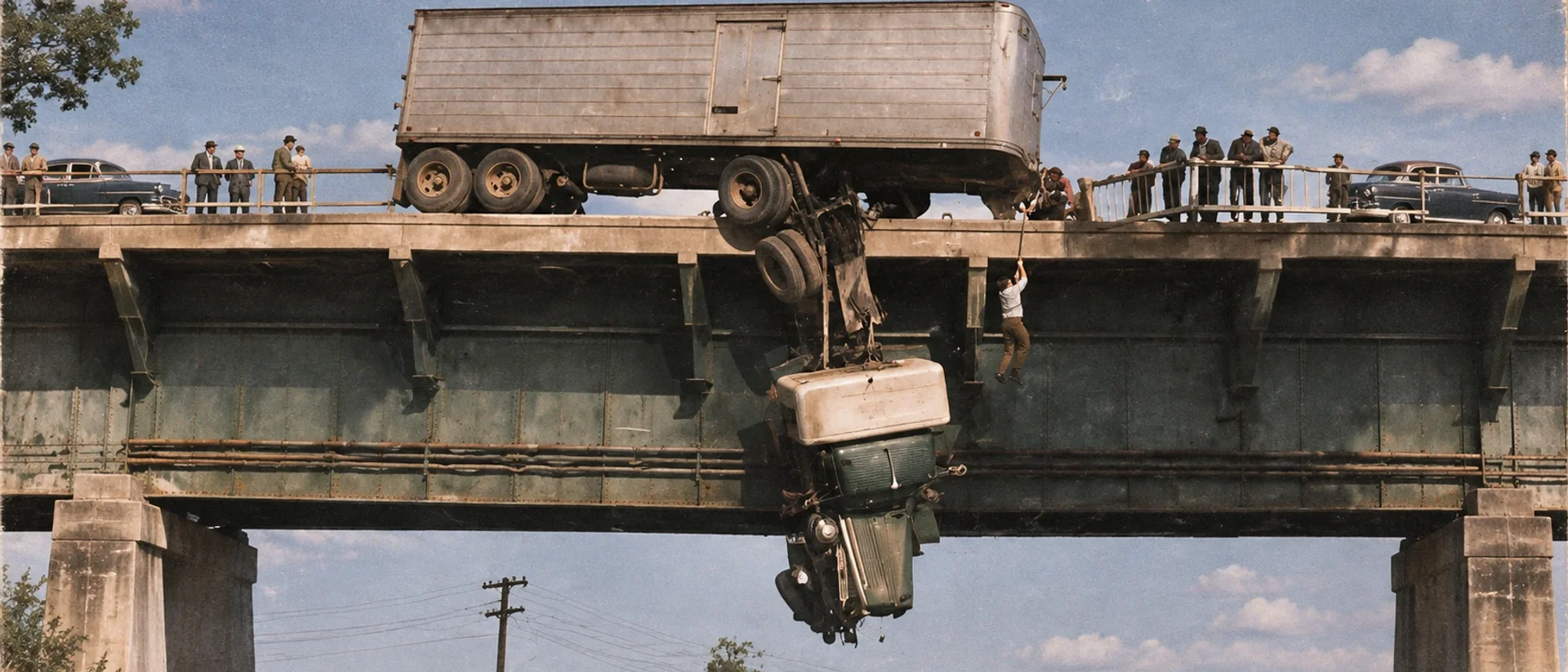
In 1953 Walter Schau hung by his ankles off a bridge north of Redding, California, to lower a rope to a trucker whose cab dangled 40 feet above the water, then climbed down into the burning cab for the second man. His wife photographed the rescue with the last two frames on her Brownie camera, and the picture won the 1954 Pulitzer Prize as the first for photography ever won by a woman.
He Hung by His Ankles. She Had Two Frames Left.
On May 3, 1953, a produce truck from Portland lost its steering on the Pit River Bridge north of Redding, California, and smashed through the steel railing. The trailer stayed on the bridge. The cab, with two men trapped inside, hung over the edge about 40 feet above the water.
A Fishing Trip Turns Into a Rescue
Walter Schau was taking his wife Virginia and her parents to the opening of fishing season when the truck failed on the road near them.
Schau stopped traffic and found a length of rope. J. D. McLaren of Concord and other motorists joined him.
The cab's rear wheels were jammed between the side of the bridge and the trailer, which is what kept it from dropping.
Upside Down Over the Water
Schau hung by his ankles over the edge and lowered the rope to the driver, Paul Overby. Overby grabbed on, and Schau, McLaren and other motorists pulled him up.
That left Overby's helper, Henry Baum, still inside the cab and only semi-conscious. Then the cab caught fire.
Schau climbed down and pulled Baum out. Moments later the cab, fully ablaze, fell into the water below.
The Last Two Frames
While the men worked, Virginia went to the car for the Brownie camera her sister had given her. She later said she was "the kind of person who always takes a camera on a trip and never takes a picture."
It was the first time she had picked the camera up in more than a year, and two exposures were left on the roll. She ran to a knoll across from the dangling cab and used both.
From a Family Roll to a Pulitzer
Her father reminded her of the Sacramento Bee's weekly photo contest. She entered the picture, won, and the Associated Press then distributed it around the world.
Almost a year to the day later she was "flabbergasted" to learn that "Rescue on Pit River Bridge" had won the 1954 Pulitzer Prize for Photography. She was the first woman to win it, and only the second amateur.
The photo shows the cab hanging off the bridge deck with a man on a rope beside it.
Source:Wikipedia
Enjoyed this fact?
Be the first to love this
Get a new fact every morning.
A fascinating fact in your inbox every morning. Free. Unsubscribe anytime.
Frequently Asked Questions
Who took the Rescue on Pit River Bridge photo?
Was Virginia Schau the first woman to win the Pulitzer for photography?
What happened to the truckers in the Pit River Bridge rescue?
Where is the Pit River Bridge?
Verified Fact
Verified Nov 7, 2026 · 3 sources checked
Source: WikipediaShow verification details
Claims checked
- A trucker's cab hung about 40 feet over the water from the Pit River Bridge north of Redding on May 3, 1953
- Walter Schau, hanging by his ankles, lowered a rope to the driver, then climbed down and pulled the second man out before the cab fell
- Virginia Schau shot the photo on the last two exposures of her Kodak Brownie
- The photo won the 1954 Pulitzer Prize for Photography, the first won by a woman
- Claim that neither trucker died corrected to say both were pulled out before the cab fell
Sources: Wikipedia, Wikimedia Commons, Encyclopedia.com
Related Topics
More from History & Culture
View all History & Culture →