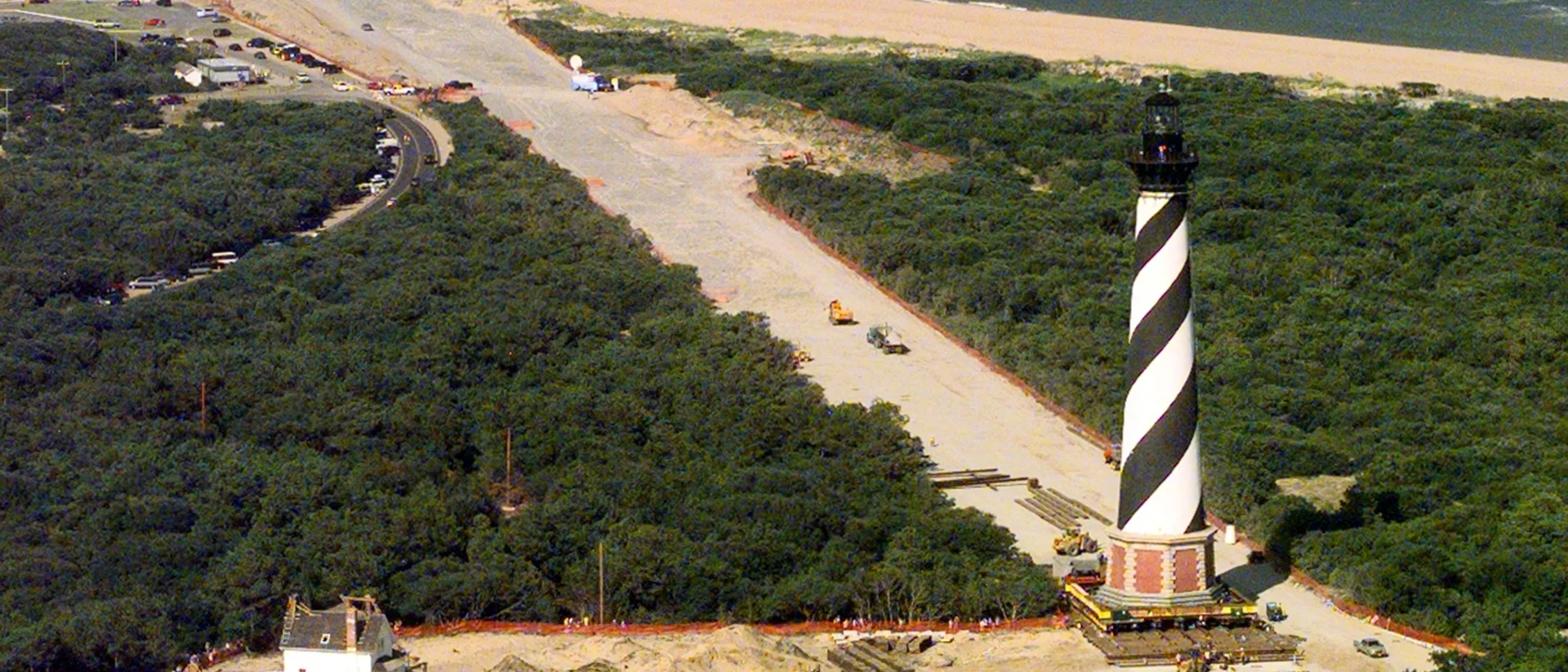
Cape Hatteras Lighthouse is the tallest brick lighthouse in America, nearly 200 feet tall. At its closest, the Atlantic had come within 120 feet of its base. So engineers lifted the entire tower onto steel rails. They rolled it more than half a mile inland, five feet at a time. It took 23 days. Not one new crack formed in the century-old brick.
How They Moved a Nearly 200-Foot Lighthouse Half a Mile
For more than a century, the tallest lighthouse in America barely had to think about the ocean. By the late 1990s, the ocean was the only thing anyone could think about.
A Beacon Built to Last
The Cape Hatteras Lighthouse first shone its light in 1870, on North Carolina's Outer Banks. Built from more than a million bricks, it became the tallest brick lighthouse in the United States, standing nearly 200 feet above the sand. When it was finished, the ocean was a comfortable 1,500 feet away.
The Sea Closes In
That distance did not last. Storms and shifting currents ate away at the shoreline decade after decade. At its closest, the Atlantic had come within 120 feet of the lighthouse's base. Engineers warned that a single major storm could topple more than a century of history into the sea.
The Move of the Millennium
In 1999, the National Park Service chose an option few thought was possible: pick the entire lighthouse up and move it. Workers separated the 4,830-ton tower from its foundation and set it onto a system of steel track beams and roller dollies. Hydraulic push jacks, clamped to the rails, inched the structure forward five feet at a time while sixty automated sensors tracked its tilt, vibration, and load transfer every step of the way.
Twenty-Three Days Later
The lighthouse began moving on June 17, 1999, and reached its new foundation on July 9, having traveled 2,900 feet, more than half a mile inland. It reopened to visitors that November. The new site put the tower 1,600 feet from the water, a buffer expected to hold for roughly a century. The American Society of Civil Engineers later named the relocation an Outstanding Civil Engineering Achievement.
The lighthouse still stands where it was left that July, its century-old brick without a single new crack from the move that many said could not be done.
Frequently Asked Questions
How tall is the Cape Hatteras Lighthouse?
Why was the Cape Hatteras Lighthouse moved?
How far was the Cape Hatteras Lighthouse moved?
How did engineers move an entire lighthouse?
When did the Cape Hatteras Lighthouse move happen?
Verified Fact
Verified true payoff instead: no new cracks formed in the tower's brick during the move, confirmed by WJE
Source: National Park ServiceShow verification details
Audited 2026-07-05 by fact-verifier (independent pass, separate from content-creator self-check). Primary source read in full: NPS "Moving the Cape Hatteras Lighthouse" (nps.gov/caha) - confirms 4,830-ton tower, tallest brick lighthouse in US, 2,900 feet moved (1999-06-17 to 1999-07-09), reopened 1999-11-13, ocean within 120 feet "by 1970" (not 1999 - creator's advisor-caught fix confirmed correct), original site 1,500 ft from ocean / new site 1,600 ft from ocean, steel track beams + roller dollies + hydraulic push jacks, sixty sensors. Cross-checked: ASCE.org + publicworks.com confirm 2000 Outstanding Civil Engineering Achievement (OCEA) award - CONFIRMED, kept. "23 days" duration confirmed by multiple independent secondary sources (WITN, npshistory.com, Our State) despite NPS phrasing "approximately 22 days of active movement" - kept as the widely-corroborated figure. TWO ERRORS FOUND AND CORRECTED: (1) INVENTED DETAIL - sensor purpose: creator's article/FAQ/engagement-comment claimed sixty sensors "monitored the brickwork for the first sign of a crack" / "to catch the first sign of stress cracks." NPS primary source explicitly states the sensors measured "the transfer of the load, tilt, vibration, and shaft diameter" - crack-detection was never the stated purpose. Corrected article, FAQ answer, and social_engagement_comment to say sensors "tracked tilt, vibration, and load transfer" (matches NPS exactly). (2) FALSE CLOSER/KICKER (most serious) - creator's text/social_text/article all closed on "The light never stopped shining" / "its light unbroken by the move." This is FALSE: lighthousefriends.com and multiple corroborating secondary sources state the light was dark from the move until it was "relit" / "resumed its duties" on 1999-11-13, the same day it reopened to the public - a roughly 4-month gap, not continuous operation. This is the exact reversed-detail failure mode (Easter-egg-hunt precedent) - caught before publish. Replaced the closer across text, social_text, and article's final paragraph with a verified true payoff instead: no new cracks formed in the tower's brick during the move, confirmed by WJE (Wiss, Janney, Elstner Associates, structural engineers on the project): "no existing cracks increased, and no new cracks developed." Also fixed a pre-existing text/social_text mismatch (text was missing the leading "The" that social_text's bold markdown never included - text now matches social_text-stripped exactly per the plain-text rule). Numeric coherence: all figures (nearly 200ft height, 120ft closest approach, 4,830 tons, 2,900ft/half-mile, 5ft increments, 23 days, 1,500ft original / 1,600ft new distance from ocean) reconcile internally and against the NPS source. Citation fidelity: source_url (NPS official move page) directly supports every headline specific (weight, distance, dates, method) - PASS, unchanged. Engine label: engine=2 (recognizable landmark IS the story) confirmed correct - the entire narrative is the lighthouse's own physical relocation, not a famous name/brand dropped into unrelated trivia. No change. Fields changed this pass: text, social_text, social_engagement_comment, article (2 paragraphs), one FAQ answer. social_caption and social_link_comment were already clean (no crack/light claims) - verified, no change needed. No scheduled_posts existed yet (publish_at still 2099 placeholder, never queued) so no cascade/cancellation needed. image_social not yet set (pre-imaging stage) so no image nulling needed.
Related Topics
More from Places & Culture
View all Places & Culture →