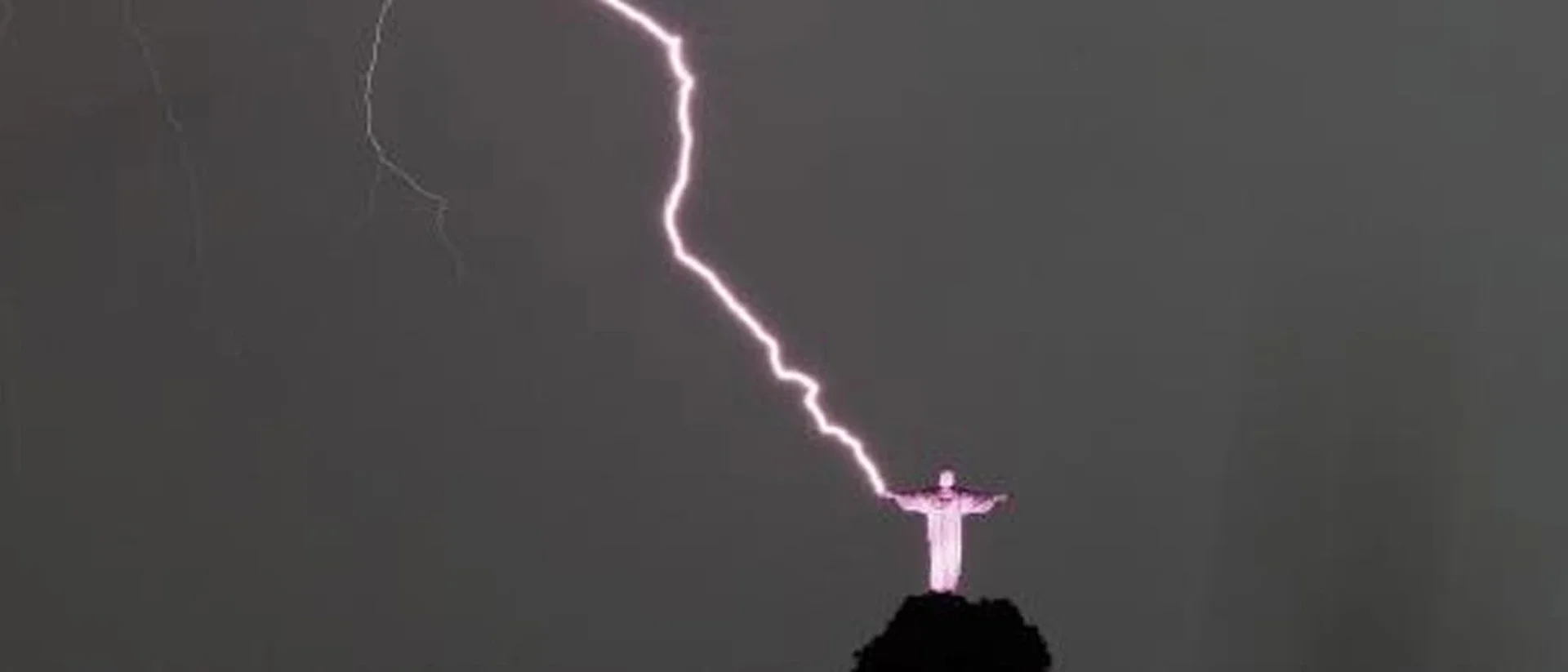
Christ the Redeemer towers over Rio de Janeiro with its arms outstretched. Lightning strikes it 3 to 5 times every year. A 2014 storm blew the tip off the right thumb. The church keeps a stock of original soapstone to repair each strike.
Christ the Redeemer Gets Struck by Lightning Up to 5 Times a Year
Christ the Redeemer stands 38 metres tall on the summit of Corcovado mountain, arms spread wide, watching over Rio de Janeiro. It is one of the most recognised landmarks on the planet. It is also one of the most frequently struck by lightning.
A Target in the Sky
The peak that holds the statue sits high above the city, exposed to the Atlantic storms that roll in off the sea. According to Brazil's National Institute for Space Research, the statue is struck by lightning 3 to 5 times every year. Most strikes are absorbed by the existing lightning rods. Others are not.
The 2014 Damage
On January 16, 2014, an electrical storm swept through Rio de Janeiro. In three hours, the city recorded 1,109 lightning strikes. One of them hit Christ the Redeemer directly, breaking off the tip of the right thumb. The damage was discovered the following morning. Workers rappelled down the outstretched arm to assess the loss.
It was not the first time. A storm in February 2008 had already struck the statue, damaging the head, eyebrows, and fingers. After the 2014 hit, engineers approved a project to extend the lightning rods - but the site is so exposed that complete protection is not possible.
The Soapstone Stockpile
The outer shell of Christ the Redeemer is covered in soapstone tiles, a material chosen for its durability and ease of working. When lightning strips pieces away, the Archdiocese of Rio de Janeiro replaces them using stone from the same original source. Father Omar Raposo of the Archdiocese confirmed that the church keeps a dedicated stock of the original soapstone for exactly this purpose.
The priest offered a dry summary of the situation: "They say lightning does not strike the same spot twice. But with the Christ, it does."
A Wonder of the World - and a Lightning Rod
Christ the Redeemer was completed in 1931 and voted one of the New Seven Wonders of the World in 2007. It draws around 2 million visitors a year. Most come to see the view. Fewer know that the statue they are standing beneath has been quietly patched back together, piece by piece, after storms that keep coming back.
Frequently Asked Questions
How often does lightning strike Christ the Redeemer?
What damage did the 2014 lightning strike cause to Christ the Redeemer?
What material is Christ the Redeemer made from?
Has Christ the Redeemer been struck by lightning more than once?
When was Christ the Redeemer built?
Verified Fact
Verified Jun 8, 2026 · 7 sources checked
Source: Smithsonian MagazineShow verification details
Claims checked
- Struck by lightning 3 to 5 times per year
- 2014 storm damaged the right thumb
- Church keeps original soapstone for repairs
- Lightning rods were extended after 2014 (not added)
Sources: Smithsonian Magazine, Wikipedia, LatinPost, ABC News, NBC News, Christian Post, Yahoo Sports
Related Topics
More from Places & Culture
View all Places & Culture →