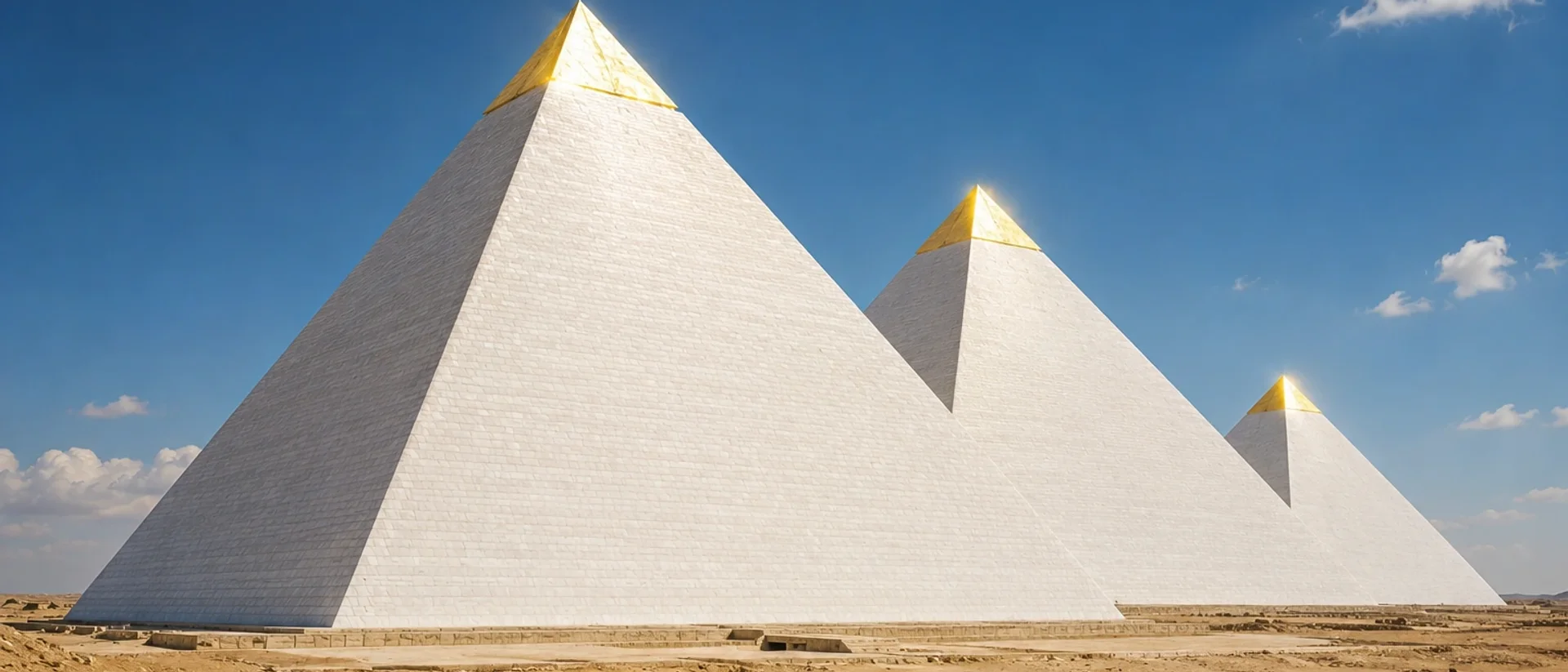
The Great Pyramids of Giza were once covered in polished white limestone blocks so smooth that a knife blade could not fit between them. In sunlight they blazed like mirrors across the desert. In 1303, an earthquake loosened the casing. A sultan stripped the stones to build mosques in Cairo - and the rough stepped core we see today is what was left behind.
The Pyramids Were Never Brown - They Were Blazing White
The image burned into millions of minds is wrong. The Great Pyramids of Giza - those ancient, sandy-brown stepped hulks rising from the desert - were never supposed to look like that. When completed, they were something else entirely: blinding, mirror-smooth towers of white, blazing in the Egyptian sun.
Encased in White Fire
When Khufu's Great Pyramid was completed around 2560 BC, its entire surface was sheathed in polished white Tura limestone - quarried from cliffs across the Nile and transported by boat to Giza. These were not rough chunks. Egyptologist Flinders Petrie, measuring the surviving joints, described the precision as equal to opticians' work of the present day, but on a scale of acres. The gaps between casing stones averaged just 0.5 millimetres - tight enough that a knife blade would not fit between them. In direct sunlight, the polished surface reflected like a mirror.
The Earthquake That Changed Everything
For over 3,000 years the white casing held. Then, on 8 August 1303, a massive earthquake struck northern Egypt and dislodged vast sections of the outer limestone. The stones had not crumbled - they had simply shifted loose, ready for the taking. In 1356, Bahri Sultan An-Nasir Nasir-ad Din al-Hasan made a fateful decision: the casing stones would be hauled to Cairo and used as building material. Mosques and fortresses rose across the medieval city - built, in part, from the outer skin of the oldest wonder of the ancient world. Later, in the early 19th century, Muhammad Ali Pasha stripped yet more casing blocks to build the Alabaster Mosque, also in Cairo.
What Survived
A few original casing stones still sit in place at the base of the Great Pyramid, excavated in 1837. Their smooth polished faces are a stark contrast to the rough steps towering above. One original casing stone is on display at the British Museum. The joints remain so precise they still look machine-made - yet they were cut and fitted entirely by hand, roughly 4,500 years ago.
The Gold Capstone Myth
Popular accounts often claim the pyramids were topped with a solid gold capstone. No pyramidion from Khufu's pyramid has ever been recovered - it was already missing in classical antiquity. Every known 4th-Dynasty pyramidion found by archaeologists is white limestone, not gilded. Gilded capstones only appear on later 5th-Dynasty pyramids. The white pyramid was extraordinary enough without the legend.
Frequently Asked Questions
What were the Great Pyramids originally covered with?
Why did the Great Pyramids lose their white limestone casing?
Are any original casing stones still visible today?
Was the Great Pyramid topped with a gold capstone?
How precise was the masonry on the Great Pyramids?
Verified Fact
5 sources checked
Source: Wikipedia - Great Pyramid of GizaShow verification details
Claims checked
- White Tura limestone casing
- 0.5mm joint precision
- Knife blade test
- 1303 earthquake
- Sultan al-Hasan 1356 stripping
- Muhammad Ali Pasha / Alabaster Mosque
- Gold capstone = myth
- 1837 excavation