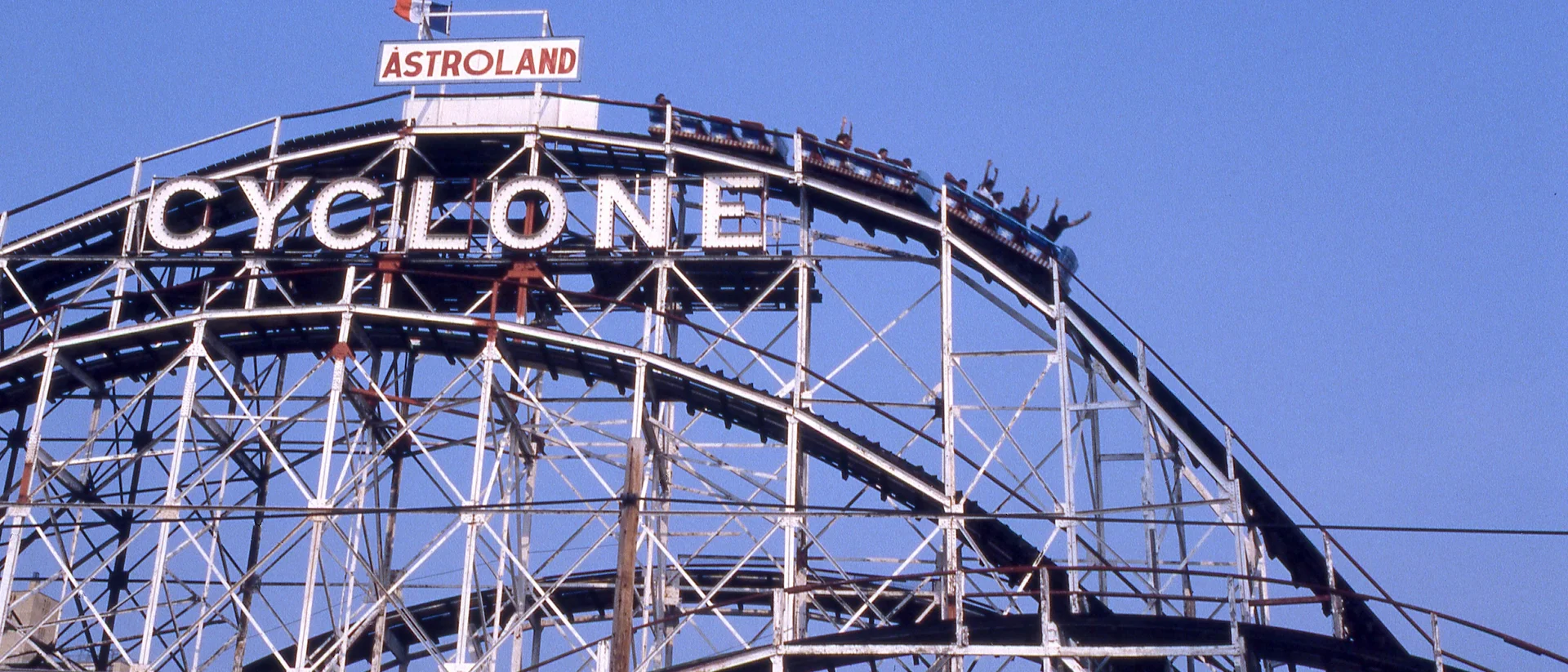
The Coney Island Cyclone is a wooden roller coaster that has run since 1927. In 1972, the city planned to bulldoze it to expand the aquarium next door. Fans and a local park owner fought back with a campaign called Save the Cyclone. It worked. New owners reopened the ride in 1975. You can still ride it every summer, dropping 58 degrees at 60 miles an hour.
Coney Island Wanted to Bulldoze the Cyclone. It Still Runs
New York City once had a plan to turn one of its most famous rides into a swamp. In 1972, officials at the New York Aquarium wanted the land under the Coney Island Cyclone for an animal exhibit. The wooden coaster was supposed to come down. It never did.
A Coaster Built for Coney Island's Golden Age
The Cyclone opened on June 26, 1927, on Coney Island's boardwalk in Brooklyn. It was designed by engineer Vernon Keenan and built from wood and steel, with a first drop of 58.1 degrees that sends riders down at up to 60 miles an hour.
It quickly became one of the most famous roller coasters in the world. Riders paid a quarter to ride it in its first years, back when Coney Island was packed with wooden coasters built to draw summer crowds from across the city.
The Swamp That Almost Replaced It
By the early 1970s, most of those other coasters were already gone. In 1972, the city-run New York Aquarium, which sits next to the Cyclone, proposed tearing the ride out to make room for a new exhibit.
The plan pitted the aquarium against local business owners and coaster fans, who did not want to lose one of the last physical links to Coney Island's amusement park heyday.
Save the Cyclone
Opponents organized a public campaign called Save the Cyclone to fight the demolition plan. The fight dragged on for years before the city agreed on a new operator.
In 1975, Dewey and Jerome Albert, owners of the neighboring Astroland amusement park, signed an agreement with the city to take over and run the Cyclone themselves.
The ride reopened on July 3, 1975, three years after the demolition plan was first announced.
From Endangered to Landmark
The rescue changed how the city treated the ride. New York City designated the Cyclone an official landmark on July 12, 1988. It joined the National Register of Historic Places on June 25, 1991.
Astroland ran the coaster until the park closed in 2008. Luna Park took over operations in 2011 and has kept the Cyclone running every season since.
Still Running
Nearly a century after it opened, the Cyclone still drops riders at 58 degrees and 60 miles an hour on its original 1927 layout. It runs every summer on the same stretch of Coney Island boardwalk the aquarium once wanted for itself.
The swamp exhibit was never built where the Cyclone stands. The coaster was.
Frequently Asked Questions
How old is the Coney Island Cyclone?
Why did New York City want to demolish the Cyclone?
Who saved the Coney Island Cyclone?
Is the Coney Island Cyclone a landmark?
How fast does the Coney Island Cyclone go?
Verified Fact
Verified Sep 4, 2026 · 2 sources checked
Source: WikipediaShow verification details
Claims checked
- The Coney Island Cyclone opened in 1927 on the Coney Island boardwalk
- In 1972 the neighboring New York Aquarium proposed demolishing it for a new exhibit
- A public campaign called Save the Cyclone fought the plan
- A father and son who ran the neighboring Astroland amusement park took over and reopened the ride in 1975 (corrected from husband and wife)
- New York City made it an official landmark, dated to July 12, 1988 (corrected from June 12)
- It joined the National Register of Historic Places in 1991
- The first drop is about 58 degrees at up to 60 miles an hour
Sources: Wikipedia, NYC Landmarks Preservation Commission designation report
Related Topics
More from Places & Culture
View all Places & Culture →