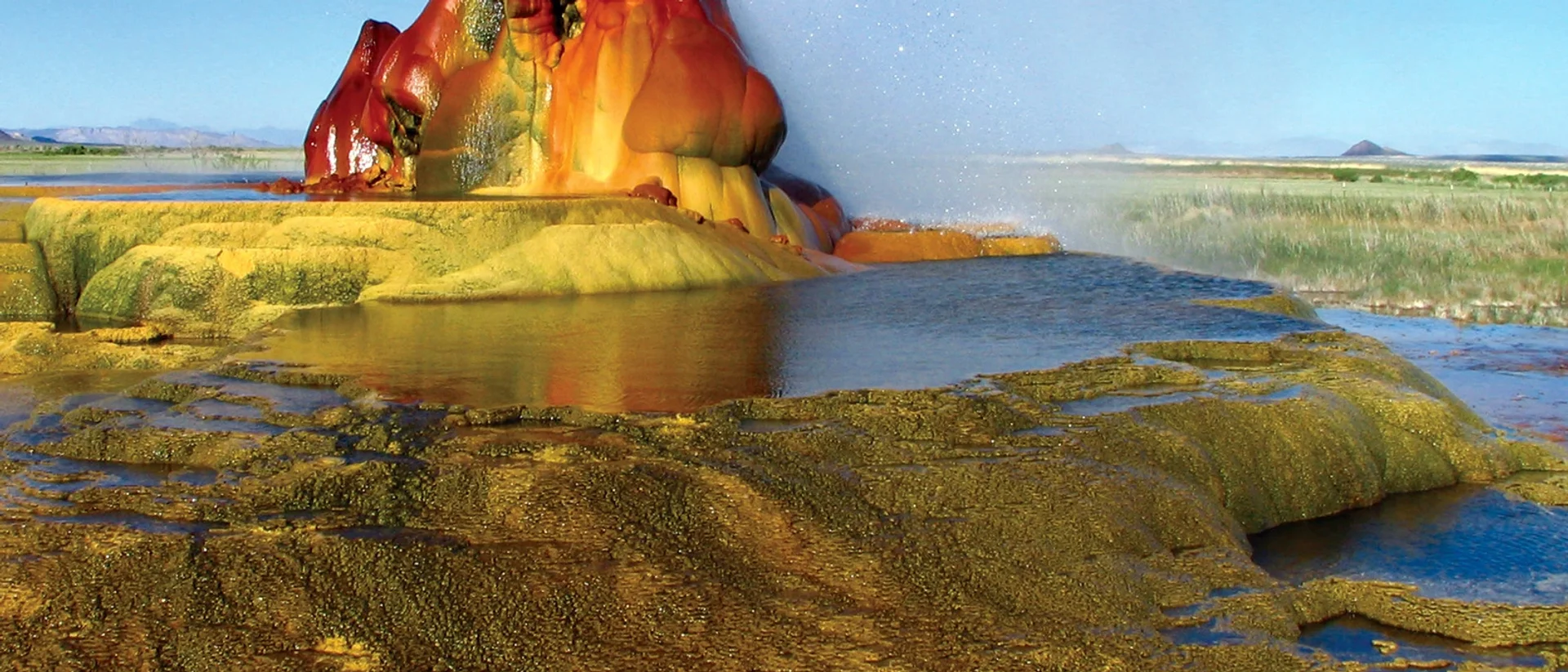
Fly Geyser looks like something from another planet, its mounds streaked bright red and green in the Nevada desert. Nobody designed it. In 1964, engineers drilling a geothermal test well left it uncapped, and scalding mineral water has erupted nonstop ever since. The rainbow colors come from algae that thrive in the hot mineral runoff, and the mound is still growing today.
The Nevada Geyser Nobody Meant to Create
Out in the Black Rock Desert of northern Nevada, a mound of rock spits scalding water into the air every second of every day. Its surface is streaked with electric red, green, and orange, like something painted by an alien hand. Nobody designed it. Nobody wanted it to look this way. It exists purely because someone forgot to plug a hole in the ground.
A Well That Missed Its Mark
In 1964, a geothermal energy company drilled a test well on what is now called Fly Ranch, hoping to tap into underground heat that could be turned into power.
The water they hit was hot, but not hot enough for their plans. The crew moved on and left the well uncapped.
That was not the site's first close call with geothermal drilling. Back in 1916, a separate well drilled for irrigation water struck near-boiling water instead and was abandoned, leaving a smaller calcium carbonate cone behind.
When the 1964 well began releasing pressure, the older geyser dried up and the newer one took over for good.
An Eruption That Never Stopped
Without a cap to hold it back, mineral-rich water under pressure began forcing its way to the surface. It has not stopped since.
Water still shoots roughly 5 feet into the air, and the minerals it carries, mostly calcium carbonate and silica, harden into rock as they hit open air. Layer by layer, those deposits built the travertine mound that tourists now photograph.
The main cone stands about 6 feet tall and 12 feet wide, but the full terrace it sits on has grown to 25 to 30 feet tall, and it is still climbing every year.
Where the Colors Come From
The water erupting from Fly Geyser can exceed 200 degrees Fahrenheit.
As it flows down the mound and cools across the terraces, it creates a range of temperature zones where different thermophilic algae and bacteria can survive, organisms built to thrive in hot, mineral-heavy runoff where most other life cannot.
Different species and mineral deposits color different parts of the mound, giving it deep reds, mossy greens, and streaks of orange across every terrace.
From a distance, it looks more like a coral reef than a rock formation rising out of the desert.
Saved by the Festival That Made Nevada Famous
Fly Geyser sits on private land about 20 miles north of Gerlach, Nevada, not far from the playa where Burning Man is held every year.
In June 2016, the nonprofit Burning Man Project bought the entire 3,800 acre Fly Ranch property, including the geyser, for $6.5 million, funded entirely by private donations rather than festival ticket sales.
The purchase was framed as a way to protect the land's wetlands, natural hot springs, and the geyser itself.
Since 2018, the organization has opened limited public access through guided walking tours across the ranch.
Visitors can see the geyser up close, something that was impossible for decades when the land was privately held and closed off.
A Mistake That Keeps Growing
More than 60 years after that uncapped test well first broke through, Fly Geyser has never stopped erupting.
The mound keeps adding new mineral layers, the algae keeps spreading in new directions, and a failed energy experiment has become one of the strangest, most photographed landmarks in the American West.
Frequently Asked Questions
How did Fly Geyser form?
What causes the red and green colors on Fly Geyser?
Can you visit Fly Geyser?
How tall is Fly Geyser?
How hot is the water at Fly Geyser?
Verified Fact
Verified Jul 16, 2026
Source: WikipediaShow verification details
Claims checked
- 1964 uncapped geothermal test well
- 1916 predecessor well (irrigation drilling, struck near-boiling water, dried up when 1964 well took over)
- Water temp >200F
- Algae/color mechanism
- Burning Man Project $6.5M purchase, 3,800 acres, June 2016
- Funded by private donations, not ticket sales
Related Topics
More from Places & Culture
View all Places & Culture →