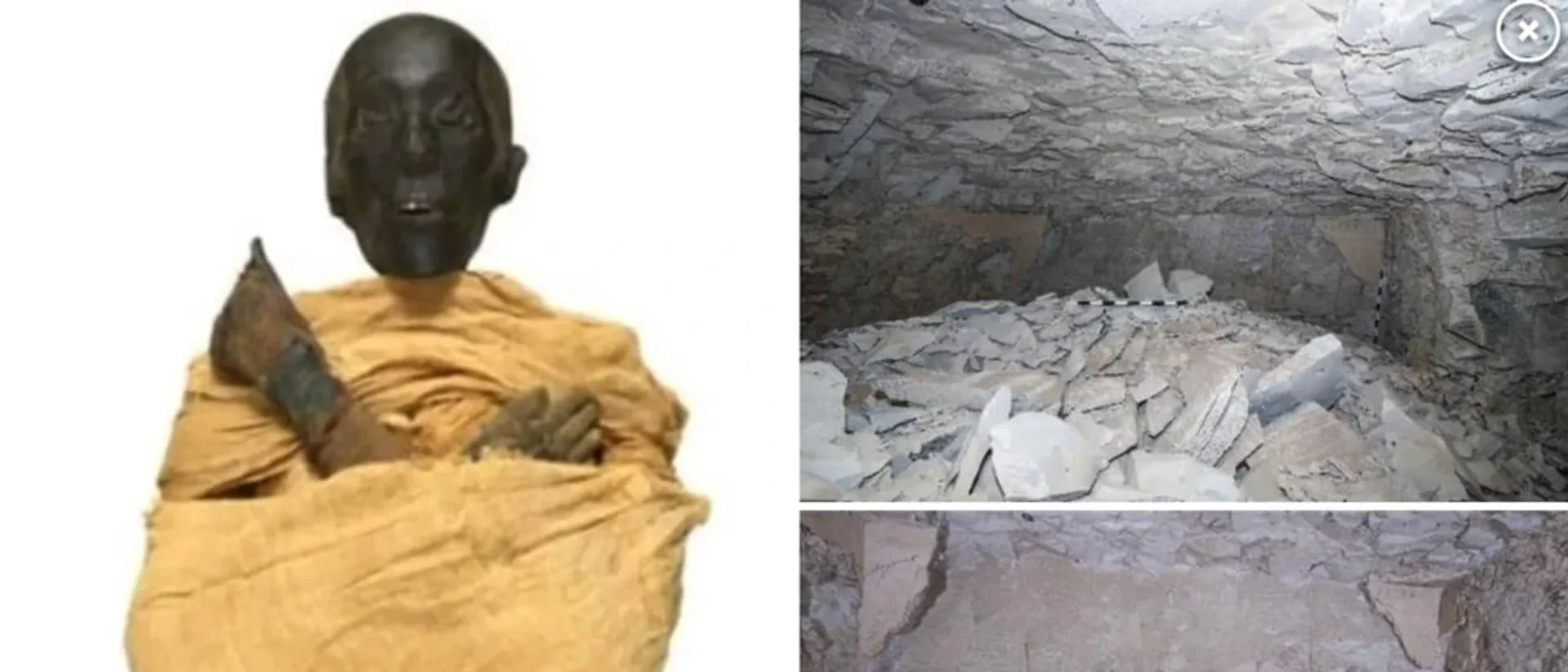
Thutmose II's lost tomb was found near Luxor in 2025. It was the first king's tomb found in the Theban hills since King Tutankhamun's - over 100 years earlier. Ancient floods damaged it and priests removed most of its contents. But fragments of the blue ceiling with its yellow stars survived 3,500 years. Those stars are only found in kings' tombs.
The First Pharaoh's Tomb Found Since King Tut
When Howard Carter cracked open Tutankhamun's burial chamber in November 1922, the world expected more royal finds to follow. The expectation lasted over 100 years in the Theban hills. In 2025, a British-Egyptian team announced something no one had managed in Luxor in a century: the lost tomb of Pharaoh Thutmose II.
Who Was Thutmose II
Thutmose II ruled ancient Egypt from roughly 1493 to 1479 BC, during the powerful 18th Dynasty. His reign lasted roughly 13 to 14 years. He died at approximately 30 years old, likely from a disease that left visible marks on his mummy. His half-sister and wife, Queen Hatshepsut, took control as regent after his death and went on to become one of the ancient world's most celebrated rulers - which may explain why Thutmose II was largely forgotten. His mummy, found separately in 1881 in the Deir el-Bahari Royal Cache, is now on display at the National Museum of Egyptian Civilization in Cairo.
The Search That Took a Century
The discovery came from a joint British-Egyptian team led by Piers Litherland of the New Kingdom Research Foundation, working alongside Egypt's Supreme Council of Antiquities. The team had been excavating Wadi Gabbanat el-Qurud - a remote valley roughly 1.5 miles west of the Valley of the Kings - since 2022. Initially, archaeologists thought the site held a queen's tomb, given its location near the burial sites of Thutmose III's wives and Hatshepsut herself. That changed when they uncovered alabaster jar fragments inscribed with Thutmose II's name and Queen Hatshepsut's name.
A Royal Ceiling Hidden for 3,500 Years
The tomb runs 95 feet long, ending in a burial chamber measuring 17 by 17 by 11 feet. Ancient floods struck the tomb shortly after Thutmose II's death, damaging the structure and leading priests to eventually relocate most of its contents. Despite this, a remarkable detail survived: fragments of a blue ceiling painted with yellow stars, along with passages from the Amduat - a funerary text reserved for kings. A walking stick made from African blackwood, with the pharaoh's name inscribed on it, was also recovered. As team leader Piers Litherland noted, blue-painted ceilings with yellow stars are found exclusively in kings' tombs - the detail that sealed the identification.
The First Since King Tut - With a Caveat
Mohamed Ismail Khaled, Secretary-General of Egypt's Supreme Council of Antiquities, called it "one of the most important archaeological finds in recent years." Officials framed it as the first royal tomb found since Howard Carter's team opened King Tutankhamun's burial chamber over 100 years ago - but that headline claim needs a caveat. In 1939 and 1940, French archaeologist Pierre Montet uncovered the intact royal tombs of Psusennes I, Amenemope, and Shoshenq II at Tanis, in the Nile Delta. Those pharaohs ruled centuries later, during the Third Intermediate Period. Thutmose II's tomb is genuinely the first pharaoh's tomb found in the Theban hills - the Valley of the Kings region - since Tutankhamun's, and the last missing burial of the 18th Dynasty kings, the royal line that gave Egypt Hatshepsut, Thutmose III, and Akhenaten among its most famous rulers.
Some Experts Want More Evidence
Not all archaeologists are fully convinced. Egyptologist Thomas Schneider has questioned the attribution, noting that the tomb's location "would be surprising for a king's tomb" and calling for further supporting details. The excavation team maintains that the combination of inscribed alabaster vessels, the royal ceiling decoration, and the tomb's scale all point to Thutmose II. Further excavation seasons are expected to provide additional evidence - and possibly more surprises.
Frequently Asked Questions
What did archaeologists find inside the tomb of Thutmose II?
Why is the discovery of Thutmose II's tomb so significant?
Where is the mummy of Thutmose II?
Who discovered the tomb of Thutmose II?
Who was Pharaoh Thutmose II?
Wasn't a royal tomb found at Tanis before this one?
Verified Fact
Verified Jun 28, 2026 · 7 sources checked
Source: Smithsonian MagazineShow verification details
Claims checked
- Lost tomb found near Luxor in 2025, first king's tomb in Theban hills since Tutankhamun's
- Floods damaged it and priests removed most contents
- Fragments of blue ceiling with yellow stars survived, a pattern only in kings' tombs
- Reign lasted roughly 13 to 14 years (was previously stated as about five)
Sources: Smithsonian Magazine, National Geographic, Archaeology Magazine, Wikipedia, CBS, Al Jazeera, Live Science