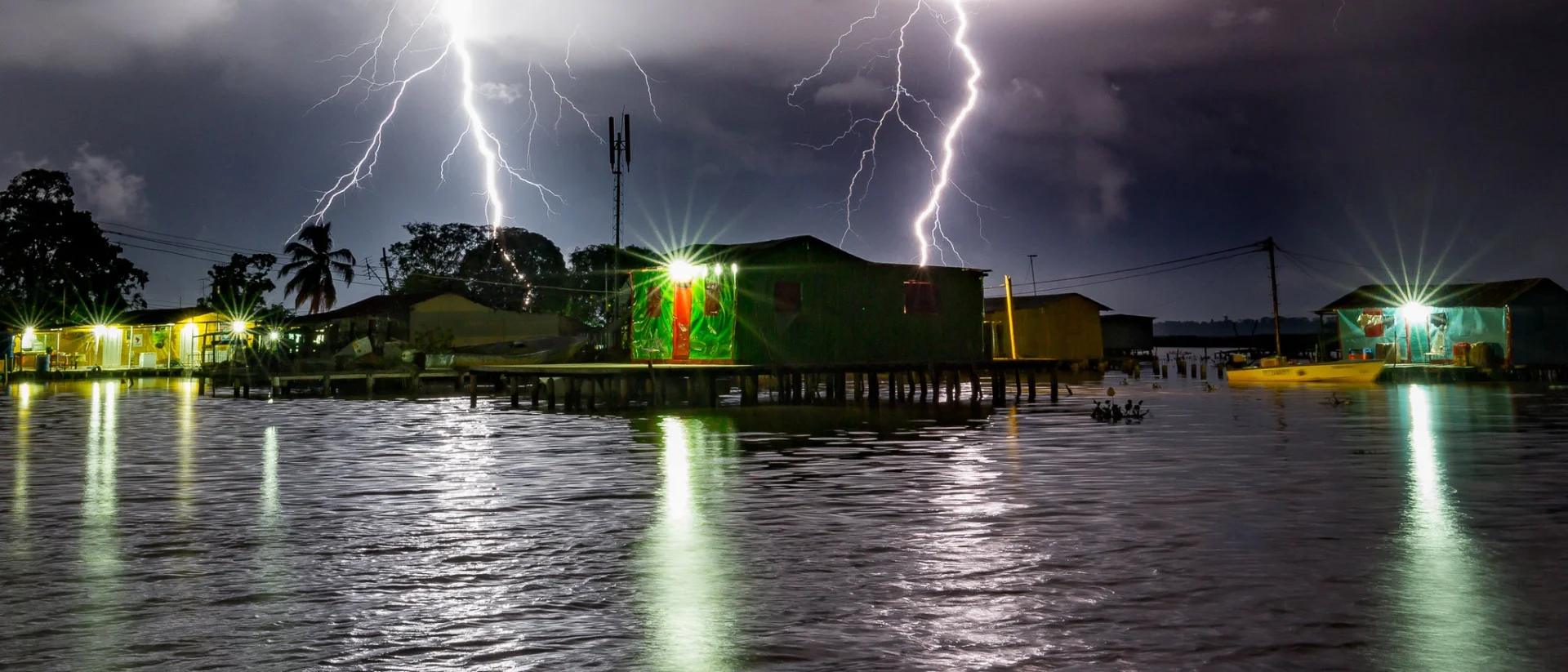
José Prudencio Padilla had 22 ships against Spain's 32 at Lake Maracaibo - and one secret weapon. The Catatumbo lightning strikes the same Venezuelan sky up to 28 times a minute, lighting up the Spanish fleet in the dark. Padilla's ambush secured Venezuela's independence in a single afternoon in 1823. This same storm still fires 260 nights a year - the most concentrated lightning on Earth.
The Lightning Storm That Helped Win Venezuela's Independence
On July 24, 1823, a Spanish admiral moved 32 warships into Lake Maracaibo after dark, confident his superior fleet would end Venezuela's independence war in a single engagement. He had more ships, more guns, and more experienced sailors. What Captain Angel Laborde did not have was the sky on his side.
The Weapon He Couldn't Plan For
Lake Maracaibo sits at the foot of the Andes in northwestern Venezuela, where warm Caribbean moisture collides with cold mountain air at dusk in a display like nowhere else on Earth. The Catatumbo lightning - named for the Catatumbo River that feeds the lake - ignites after sundown and fires continuously for up to nine hours, discharging as many as 28 flashes per minute. It has done this, with rare exceptions, for as long as records exist.
Sailors had called it the "Beacon of Maracaibo" for centuries. The light is so intense it can be seen 400 kilometers away - well out into the Caribbean. For generations it served as a navigational aid, guiding ships through the Gulf of Venezuela. On July 24, 1823, it played a different role.
The Battle That Ended the War
Venezuela had been fighting for independence from Spain for over a decade. The Battle of Lake Maracaibo was the final naval confrontation. Republican Admiral Jose Prudencio Padilla commanded 22 vessels for Simon Bolivar's Gran Colombia, outgunned and outnumbered by Laborde's 32-ship squadron. According to historical accounts, the Catatumbo lightning acted as a lighthouse for Padilla's fleet - illuminating the Spanish positions in the darkness and enabling a decisive ambush.
Padilla attacked with devastating effect. He destroyed or captured all but three Spanish vessels that cut anchor and fled. Spanish casualties included 437 captured; Republican losses were a fraction of that. Laborde had no option but to surrender all warships and installations.
It was the last major naval battle of the entire South American independence wars. Without sea power, Spain could not reinforce Venezuela, and independence was effectively secured. The date - July 24 - is now both Venezuela's Navy Day and the birthday of Simon Bolivar himself.
The Most Concentrated Lightning on Earth
Two centuries later, the same storm is still firing. In 2016, Dr. Rachel I. Albrecht and colleagues published a study in the Bulletin of the American Meteorological Society analyzing 16 years of satellite data from NASA's Tropical Rainfall Measuring Mission. Their conclusion: Lake Maracaibo is the lightning capital of the world, with 232.52 flashes per square kilometer per year - surpassing the previous record holder in the Democratic Republic of Congo. Guinness World Records also recognizes it as Earth's highest concentration of lightning.
The storm runs 260 nights a year, lighting up the same stretch of sky between dusk and 5 AM. One unusual characteristic: almost all of the world's top lightning zones strike land during afternoon hours - but Catatumbo strikes water at night, a meteorological anomaly that scientists still work to fully explain.
The Six Weeks It Went Silent
In January 2010, the lightning stopped. An exceptionally strong El Nino had triggered a severe drought across Venezuela, and for roughly six weeks between January and March - the longest absence in over a century - the sky above Lake Maracaibo was dark. Locals who had grown up watching the nightly display feared something permanent had changed. The lightning returned in April 2010 when rainfall patterns shifted back.
It has been firing every night since.
Frequently Asked Questions
What is Catatumbo lightning?
Did lightning really help Venezuela win independence?
Why is Catatumbo lightning so frequent?
Has Catatumbo lightning ever stopped?
Is Catatumbo lightning a world record?
Verified Fact
Verified Aug 26, 2026 · 5 sources checked
Source: Wikipedia / NASA EarthdataShow verification details
Claims checked
- Padilla's 22 ships defeated Spain's 32 at Lake Maracaibo in 1823
- Catatumbo lightning lit the Spanish fleet during the battle
- Storm fires up to 28 times per minute, 260 nights a year
- Lake Maracaibo is Earth's top lightning hotspot
- Storm disappeared for about 6 weeks in early 2010, then returned
Sources: Wikipedia, NASA Earthdata, Smithsonian Magazine, Mental Floss, Slate