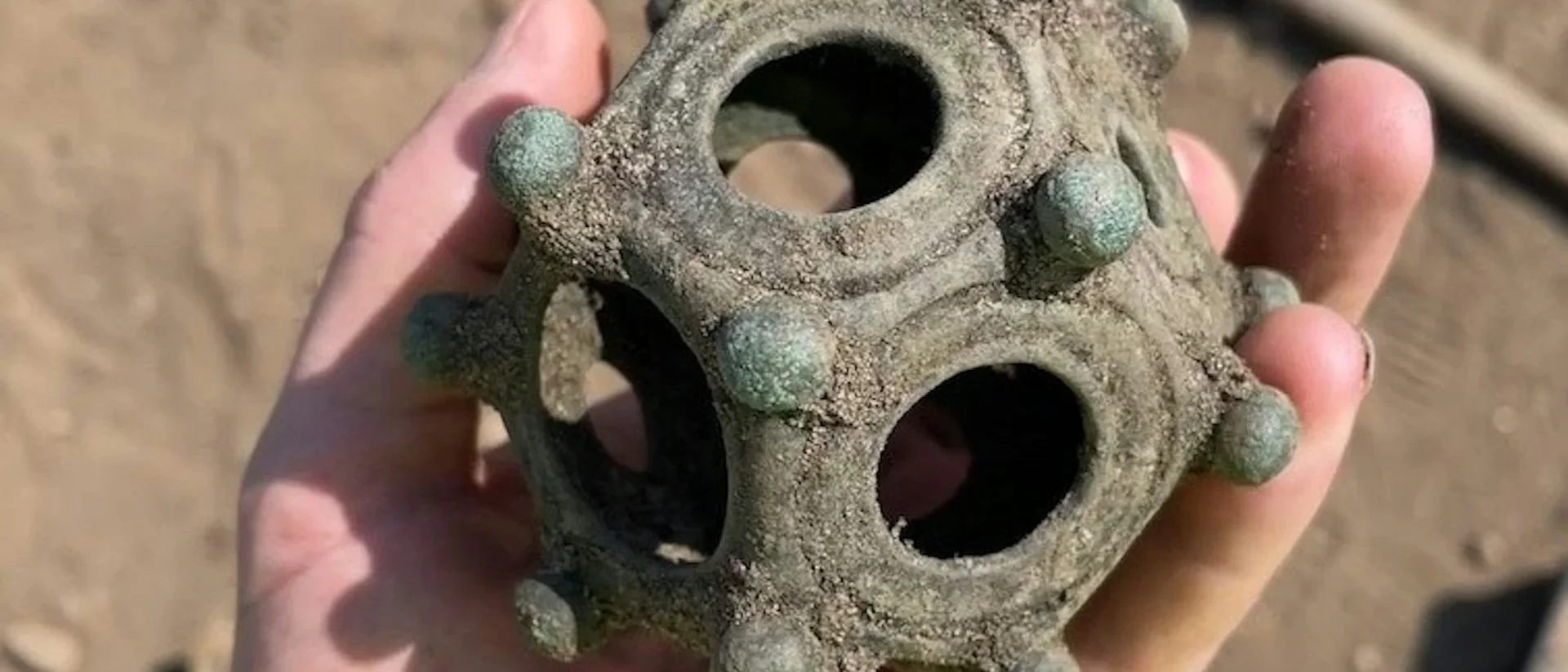
Archaeologists have found around 130 strange bronze objects across the old Roman Empire. Each one has twelve flat faces and a knob on every corner. Holes of different sizes are cut into every side. Some fit in a palm. Some are as big as a grapefruit. No Roman text, painting, or mosaic ever mentions them. Two thousand years later, nobody knows what they were built for.
Archaeologists Found 120 of These - Nobody Knows Why
Picture a small bronze object about the size of an orange. It has twelve flat faces, a knob poking out of every corner, and a different sized hole cut into each side. Now imagine finding around 130 of them scattered across an entire empire, and still not knowing what a single one was built for.
A Shape That Keeps Turning Up
Roman dodecahedra have been surfacing since at least the 1700s. Around 130 have been recovered across the northwestern provinces of the former Roman Empire, especially in Britain, France, Germany and Switzerland.
Strikingly, none have ever turned up in Italy, the political heart of Rome itself.
They range in size from about 4 to 11 centimeters across, small enough to fit in a palm or large enough to fill a hand like a grapefruit.
In June 2023, amateur archaeologists with the Norton Disney History and Archaeology Group in Lincolnshire, England, unearthed a particularly well preserved copper alloy example.
At about 8 centimeters tall and weighing 245 grams, it became the 33rd dodecahedron found in Britain and the first from the English Midlands.
It later went on public display at the Lakeside Arts museum in Nottingham and featured on the BBC series Digging for Britain.
No Instruction Manual Survives
Here is the part that makes historians uneasy. There is no known Roman text, painting, mosaic or inscription that mentions these objects at all.
Nothing in the entire surviving written record of the empire explains what they were for. Whatever they did, the Romans who made and used them never thought it worth writing down, or the record simply has not survived.
That silence is not for lack of effort on the objects themselves. Each dodecahedron took real skill to cast in bronze, with precise geometric faces and carefully drilled holes of varying diameters.
Archaeologists studying the Norton Disney piece noted it was made from a deliberate mix of copper, tin and lead, the kind of investment unlikely to be spent on something purely decorative or disposable.
Dozens of Theories, None That Fully Fit
Historians have floated close to fifty different explanations over the years.
Suggested uses include surveying and measuring tools, candlestick holders, calendar markers, scepter toppers, gaming pieces, and religious or ritual objects.
The Norton Disney group leans toward a ritual or religious explanation rooted in local superstition, while researchers at Belgium's Gallo-Roman Museum have separately proposed the objects were tied to magical rituals that had to go underground once the Christianized empire outlawed magic, one possible reason they vanish from the written record.
One theory in particular went viral online: that the dodecahedra were tools for knitting gloves, since a hobbyist demonstrated that a 3D printed replica could be used to knit finger shapes.
It is a neat demonstration, but historians point out a serious problem with the timeline.
Knitting as a craft is not documented until roughly a thousand years after the Romans stopped making these objects, which makes the theory hard to accept without much stronger evidence.
The Mystery Stays Open
No single theory accounts for every detail: the size range, the varying hole diameters, the total absence from Italy, or the total silence in the historical record.
For now, the honest answer is that nobody knows.
Centuries after the last one was cast in bronze, the Roman dodecahedron remains one of archaeology's genuine open questions.
Frequently Asked Questions
What is a Roman dodecahedron?
How many Roman dodecahedra have been found?
What were Roman dodecahedra used for?
Is the knitting glove theory about Roman dodecahedra true?
When was the most recent Roman dodecahedron discovered?
Verified Fact
Verified Jul 12, 2026 · 7 sources checked
Source: The ConversationShow verification details
Claims checked
- Around 130 bronze dodecahedra found across the old Roman Empire
- No ancient Roman text, painting, or mosaic mentions them
- None have been found in Italy
- Their purpose remains genuinely unknown
- A magic-theory was misattributed to Norton Disney; corrected to Gallo-Roman Museum researchers
Sources: The Conversation, Smithsonian Magazine, NPR, CNN, Live Science, Wikipedia, Newark Advertiser
Related Topics
More from History & Culture
View all History & Culture →