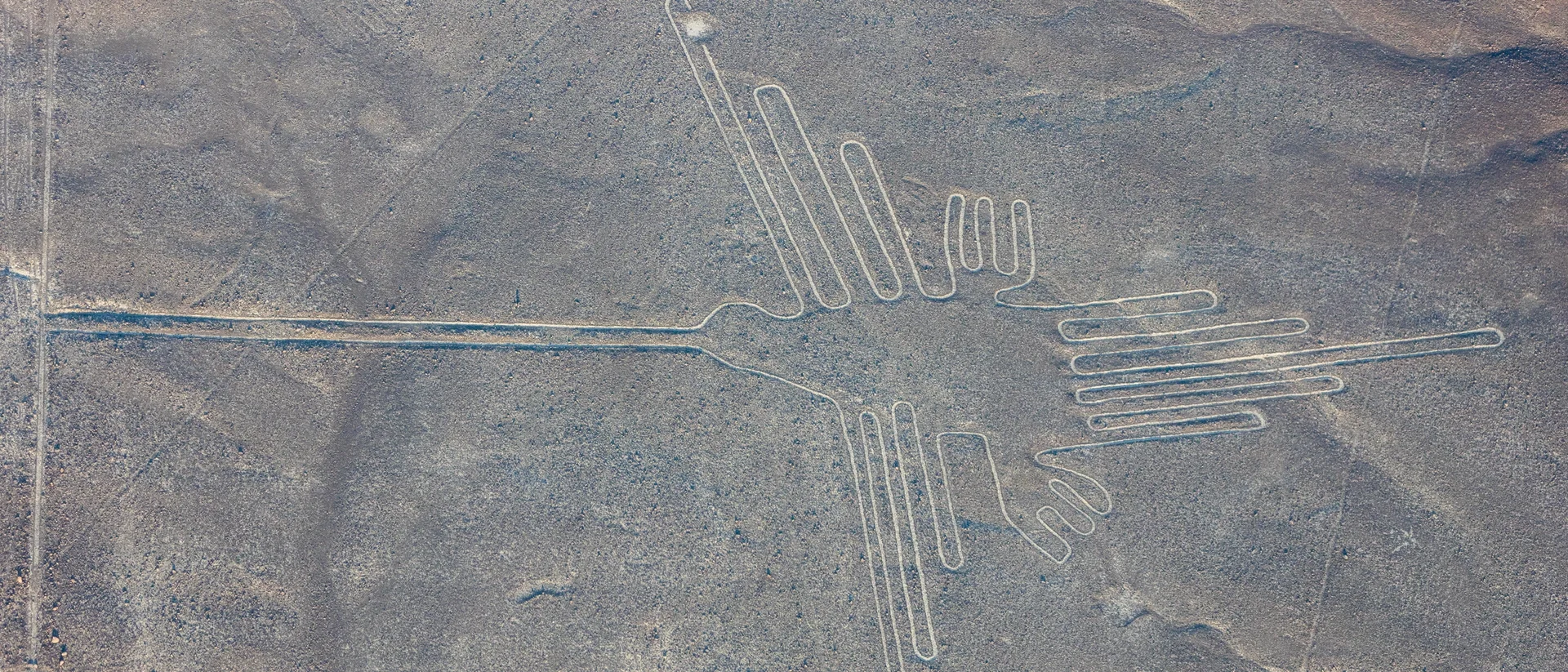
The Nazca Lines in Peru are one of the world's great ancient mysteries. Researchers spent nearly a century mapping 430 carved figures in the desert. Yamagata University asked IBM to build an AI trained on aerial imagery. In just six months, AI found 303 new figures - nearly doubling what a century of fieldwork found.
AI Found 303 New Nazca Geoglyphs in Six Months
Sometimes the world's most celebrated mysteries are also its most incomplete. Researchers had spent nearly a century studying Peru's Nazca plateau - and still only knew part of what was there.
A Desert Full of Ancient Carvings
The Nazca Lines are geoglyphs etched into a desert plateau in southern Peru. The Nasca people created them between 200 BCE and 700 CE. The largest figures stretch across hundreds of meters and can only be seen clearly from the air. The plateau has been studied continuously since the 1930s.
By 2020, researchers had catalogued just 430 known figurative geoglyphs - the result of nearly a century of fieldwork. Two types exist: large line-type geoglyphs depicting wild animals, clearly visible from altitude; and smaller relief-type carvings, faint and difficult to spot, found along ancient walking trails.
Teaching an AI to See What Humans Missed
Archaeologist Masato Sakai at Yamagata University's Institute of Nasca partnered with IBM's Thomas J. Watson Research Center to build a new approach. The team trained an AI model on aerial imagery of all 430 known geoglyphs, then applied it to the wider plateau.
The AI flagged candidate sites for field researchers to check on foot. Researchers needed to inspect an average of 36 AI-generated suggestions to confirm one genuine geoglyph. Even so, the discovery rate was 16 times faster than any previous survey of the region.
303 New Figures in Six Months
Between September 2022 and February 2023, the team confirmed 303 previously unknown geoglyphs. All were the smaller relief-type figures that earlier surveys had missed. The new carvings depict humanoids (33.8%), heads associated with ritual practices (32.9%), and domesticated animals including camelids (14.9%).
Most are positioned along ancient walking trails. Researchers believe they served as personal waymarkers or ritual signposts for small groups - quite different from the large, communal line-type geoglyphs. The findings were published in the Proceedings of the National Academy of Sciences in September 2024.
AI Nearly Doubled a Century of Work
The discovery nearly doubled the known inventory of figurative Nazca geoglyphs. Researchers plan further surveys and believe more figures remain hidden across the plateau. The project is one of the clearest demonstrations yet of AI accelerating archaeology at a major ancient site - finding in six months what had taken nearly a century by hand.
Enjoyed this? Get a new fact every morning.
A fascinating fact in your inbox every morning. Free. Unsubscribe anytime.
Frequently Asked Questions
How many Nazca geoglyphs have been discovered in total?
Who discovered the new Nazca geoglyphs using AI?
How did AI help find new Nazca Lines?
What do the newly discovered Nazca geoglyphs depict?
When were the Nazca Lines created?
Verified Fact
Verified Jun 29, 2026 · 2 sources checked
Source: Proceedings of the National Academy of SciencesShow verification details
Claims checked
- AI-assisted survey found 303 new Nazca geoglyphs
- New total of 733 known figurative geoglyphs, nearly doubling prior count of 430
- Discovery pace was 16 times faster than prior surveys
- AI was trained on aerial imagery, not drone footage; "AI found" corrected to "AI helped find"
- Work led by Yamagata University and IBM, published in PNAS (Sept 2024)
Sources: Proceedings of the National Academy of Sciences
Related Topics
More from Places & Culture
View all Places & Culture →